Updated on January 24th, 2026
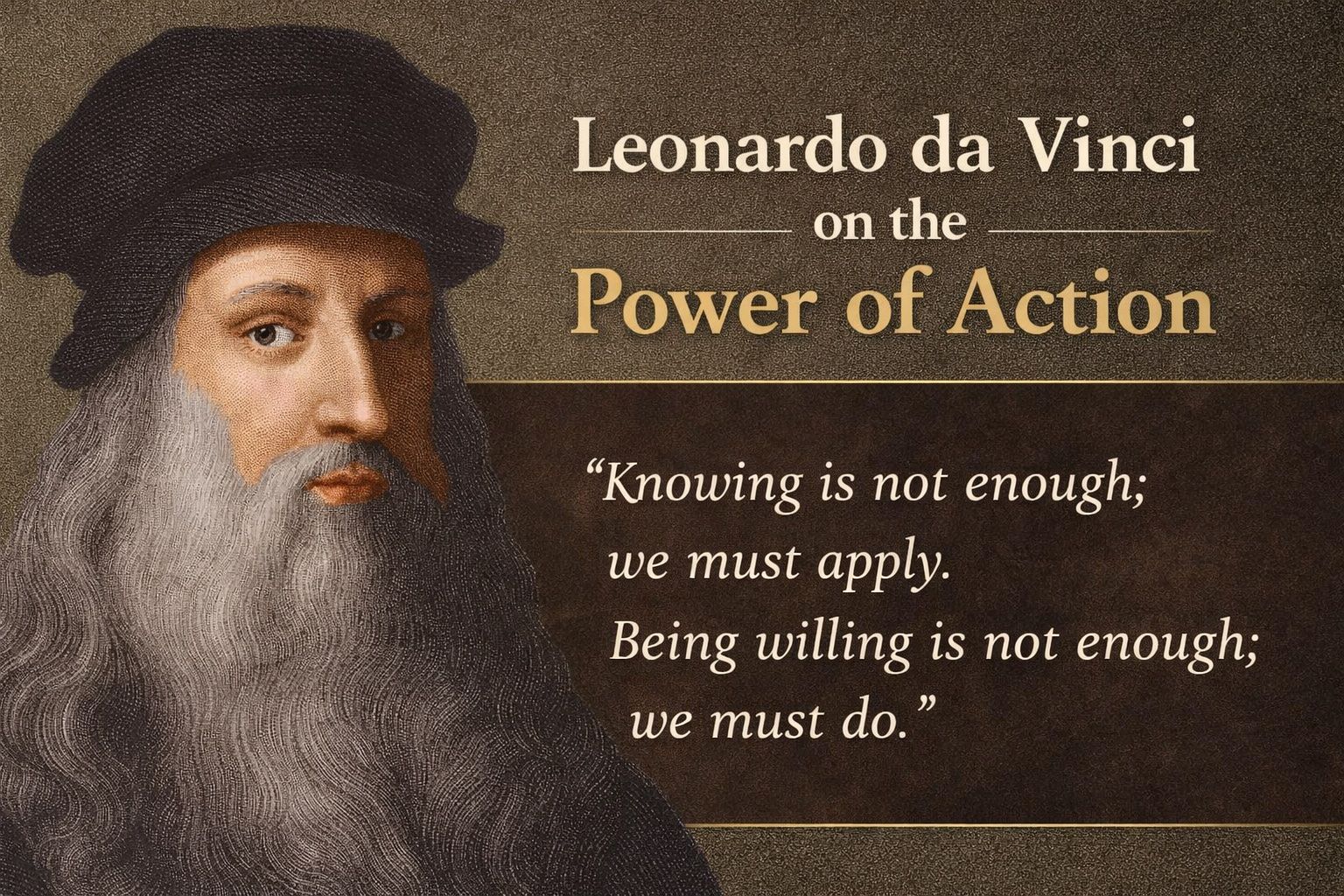
The words attributed to Leonardo da Vinci—“Knowing is not enough; we must apply. Being willing is not enough; we must do”—sounds deceptively simple. Yet within this short sentence lies a lifelong discipline. The quote does not flatter the intellect, nor does it console good intentions. Instead, it gently but firmly unsettles us. It reminds us that knowledge, when left unused, is incomplete, and willingness, when not followed by action, is only a polite form of delay.
Leonardo lived in an age of awakening, when curiosity was abundant, and discoveries were reshaping how humans understood art, anatomy, science, and nature. Yet even in such an intellectually vibrant world, he recognised a timeless human weakness: our tendency to stop at understanding, rather than moving toward execution.
Knowing Without Applying: A Silent Loss
To “know” something is often mistaken for having achieved something. We read books, attend lectures, watch talks, and gather insights. This accumulation creates a comforting illusion of progress. Leonardo challenges this illusion. Knowledge that is not applied does not transform life; it merely decorates the mind. The quote insists that learning reaches completion only when it alters behaviour, sharpens skill, or produces tangible change.
Leonardo himself was never satisfied with abstract understanding. When he studied anatomy, he dissected human bodies to see the truth with his own eyes. When he imagined machines, he sketched them meticulously, testing form and function on paper. His brilliance lay not only in thinking deeply, but in insisting that ideas must touch reality. In today’s language, he reminds us that theory without practice remains fragile and unproven.
Willingness Without Action: The Comfort of Intention
The second half of the quote strikes even closer to the heart. Many people are willing. They want to improve, to change, to grow. They speak of plans, dreams, and intentions. Yet willingness alone demands no courage. Action does.
Leonardo’s words expose how easily willingness becomes a resting place. We tell ourselves the time is not right, the conditions are not perfect, or we need one more piece of information. In truth, this hesitation often masks fear—fear of failure, judgment, or imperfection. By declaring that willingness is not enough, Leonardo removes all hiding places. He insists that transformation begins only when intention steps into motion.
A Renaissance Lesson for a Modern World
In the modern era, this quote feels more relevant than ever. We live in a time of endless information. Tutorials, courses, podcasts, and advice are always within reach. Yet this abundance has created a strange paralysis. People know more than ever, yet often do less. Leonardo’s wisdom cuts through this confusion with startling clarity. It reminds us that progress does not come from consuming more ideas, but from applying the ones we already possess.
For students, this means moving beyond passive learning into disciplined practice. For professionals, it means converting insight into execution. For creators and writers, it means producing imperfect work rather than waiting endlessly for the perfect moment. Leonardo’s message is not about speed or scale; it is about movement.
Leonardo’s Life as Living Proof
Leonardo da Vinci’s life stands as the strongest evidence of his belief. He did not confine himself to one discipline, nor did he remain satisfied with conceptual mastery. His paintings were experiments in light, emotion, and perspective. His scientific notes were driven by observation rather than assumption. Even his unfinished works reveal a restless mind constantly testing ideas against experience.
What makes Leonardo extraordinary is not simply his intelligence, but his insistence on engagement. He interacted with the world directly, trusting experience as a teacher. This is why his insights continue to feel alive centuries later. They were not born in isolation, but forged through doing.
Applying the Quote to Everyday Life
When translated into daily living, this quote becomes a quiet but powerful guide. It asks us to examine where we are hiding behind preparation. It challenges us to notice where willingness has replaced commitment. Whether one is learning a new skill, building a career, improving health, or nurturing relationships, the message remains the same: begin where you are, with what you know, and act.
Action does not require certainty. It requires honesty and courage. Leonardo’s wisdom reassures us that mistakes are not the opposite of knowledge; they are often its deepest expression. Through action, knowledge matures. Through doing, willingness gains meaning.
The Enduring Call of a Timeless Mind
Leonardo da Vinci’s quote survives because it speaks to something universal and unresolved within human nature. We are thinkers by instinct, but doers by discipline. His words do not scold; they awaken. They remind us that life rewards engagement, not contemplation alone.
In the end, the quote invites a simple but demanding shift. Do not ask only what you know. Ask how you are using it. Do not measure your intentions. Measure your actions. In that movement—from knowing to applying, from willing to doing—Leonardo believed true mastery, growth, and fulfilment quietly emerge.
Stories Around Every Turn from Kasol to Tosh

A memorable journey to Tosh filled with mountain views, peaceful streets, cafés, and unforgettable travel memories.


No Comment