Updated on June 10th, 2026
The Man Who Wrote Nothing but Changed Everything
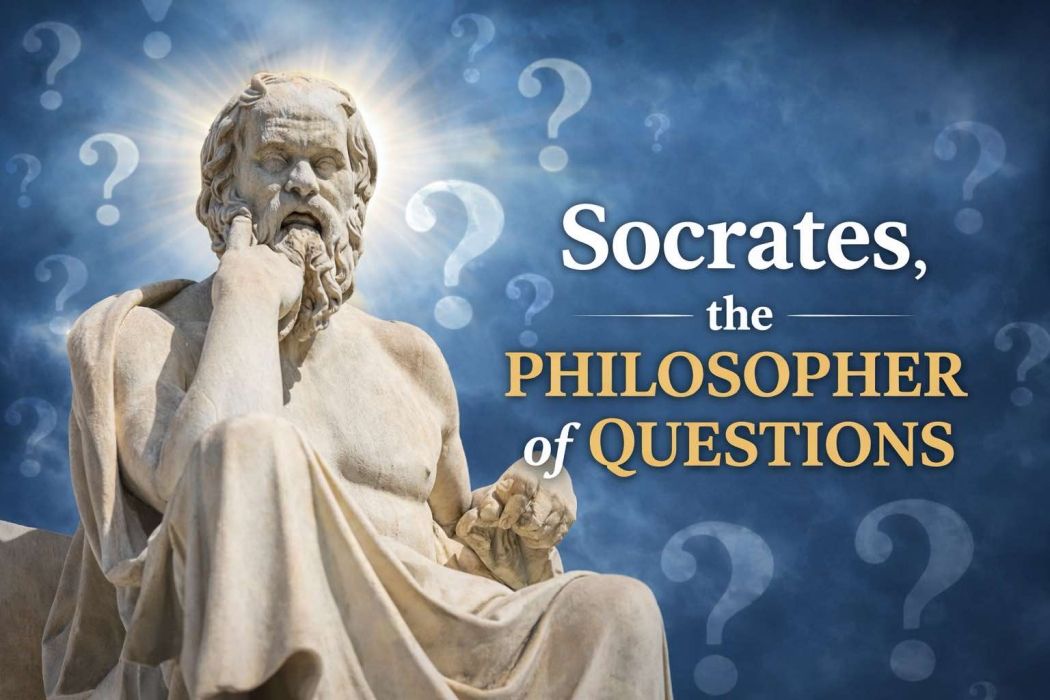
In the grand story of human thought, some thinkers wrote volumes, and others left behind institutions. And then there is Socrates—a man who wrote nothing at all, yet shaped the very foundation of philosophy as we know it. His life was not documented in books, but in conversations, questions, and the minds he transformed.
More than two thousand years ago, he walked through the streets of ancient Athens asking people simple yet powerful questions. His aim was not to lecture but to challenge people to think. Everything we know about him comes from the works of his students and contemporaries, particularly Plato, Xenophon, and the playwright Aristophanes. Despite this limitation, his influence on philosophy, ethics, and education remains profound.
For students of law and philosophy, Socrates is especially important because he introduced a method of questioning that forms the backbone of modern legal reasoning and academic debate.
Socrates and the Shift Toward Human Questions
Before Socrates, most philosophers focused on explaining the natural world—questions about the universe, matter, and nature. These thinkers are known today as the Pre-Socratic philosophers. Socrates changed the direction of philosophy entirely.
Instead of asking questions about nature, Socrates turned his attention to human life—exploring ideas such as justice, courage, the nature of a good life, and what it truly means to be virtuous. These questions might appear simple, but Socrates believed that understanding them was essential for living wisely. He famously stated that “The unexamined life is not worth living.”
This idea remains central to education today. Whether in philosophy, law, or public life, questioning assumptions is the first step toward truth.
The Life of Socrates: A Philosopher of the Streets
Socrates was born in Athens around 469 B.C. His father was a stone mason and his mother a midwife. Many historians believe that Socrates himself may have worked as a mason before dedicating his life to philosophy.
He lived a very modest life and was known for his unusual appearance and simple clothing. At a time when Athens valued physical beauty and wealth, Socrates stood in contrast—focusing instead on intellectual and moral development. He also served as a soldier during the Peloponnesian War, a major conflict between Athens and Sparta that deeply affected Athenian society.
After Athens lost the war, the city went through political and cultural turmoil. Socrates openly criticised the growing obsession with wealth, power, and superficial values. This criticism eventually made him many enemies.
The Trial and Death of Socrates
In 399 BC, Socrates was put on trial in Athens, accused of corrupting the youth and disrespecting the gods. His defence, recorded by Plato, was not an attempt to escape punishment, but a bold reaffirmation of his beliefs.
He refused to flatter the jury or beg for mercy. Even when given a chance to escape after being sentenced to death, he chose to stay, arguing that one must respect the laws of the state—even when they seem unjust.
The trial of Socrates remains one of the most famous events in the history of philosophy and justice. His defence speech, recorded by Plato in Apology, reveals his unwavering commitment to truth. Rather than abandoning his philosophical mission, Socrates defended the importance of questioning authority and encouraging young people to think critically.
He was ultimately found guilty and sentenced to death by drinking poison hemlock. Socrates had the opportunity to escape into exile, but he refused. For him, respecting the laws of Athens—even unjust ones—was part of his moral duty. His calm acceptance of death turned him into a symbol of intellectual courage and moral integrity.
The Socratic Method: The Power of Questioning
Perhaps the greatest contribution of Socrates to intellectual history is the Socratic Method, a form of dialogue that uses questions to stimulate critical thinking. Instead of giving answers, Socrates asked a series of questions that forced individuals to examine their own beliefs. This process exposed contradictions and weaknesses in their reasoning, gradually guiding them toward a clearer understanding.
The method often involved a technique called elenchus, in which Socrates would challenge a person’s claim by presenting counterexamples. Through repeated questioning and clarification, the discussion would move closer to the truth. This approach revolutionised education by shifting learning from memorising information to active thinking and reasoning.
The Socratic Method in Law and Modern Education
Today, the Socratic Method is widely used in legal education worldwide, particularly at American law schools such as Harvard Law School and Yale Law School. In a typical law classroom, a professor asks a student to summarise a judicial decision. The student is then asked whether they agree with the court’s reasoning. The professor continues asking questions, sometimes playing the role of a critic, forcing the student to defend their position. This process develops critical skills essential for legal practice:
Analytical reasoning, Logical argumentation, Identification of weaknesses in arguments, and confidence in defending legal positions. Even courts use a similar approach. Judges often ask lawyers probing questions during hearings to test the strength of their arguments.
For law students and future lawyers, learning to think like Socrates—questioning assumptions and seeking clarity—is a fundamental skill.
Socrates in the Modern World
The influence of Socrates extends far beyond philosophy classrooms. His ideas appear in modern debates about democracy, ethics, and education. In an era dominated by social media, misinformation, and quick opinions, the Socratic spirit of questioning is more important than ever. Scholars and educators increasingly encourage students to challenge information, verify facts, and engage in thoughtful dialogue.
Modern thinkers such as Martha Nussbaum argue that Socratic questioning remains essential for democratic societies because it encourages citizens to think independently rather than blindly accept authority.
The Courage to Ask Questions
Socrates did not leave behind books, wealth, or political power. What he left behind was something far more powerful—a method of thinking. By teaching people to question assumptions and examine their lives, Socrates transformed philosophy and education forever. His commitment to truth, even in the face of death, remains one of history’s greatest examples of intellectual integrity.
For law students, philosophers, and anyone seeking wisdom, the lesson of Socrates is simple but profound: truth begins with the courage to ask questions.
References
- Plato – Apology, Crito, and Phaedo
- Russell, Bertrand – History of Western Philosophy
- Nussbaum, Martha – Not for Profit: Why Democracy Needs the Humanities
- Stanford Encyclopedia of Philosophy – “Socrates”
- Internet Encyclopedia of Philosophy – “The Socratic Method”
William Wordsworth’s Timeless Lesson for a Noisy World

Explore William Wordsworth’s insight on wisdom, humility, and the beauty of simple living in a rushed world.


No Comment