Updated on July 24th, 2026
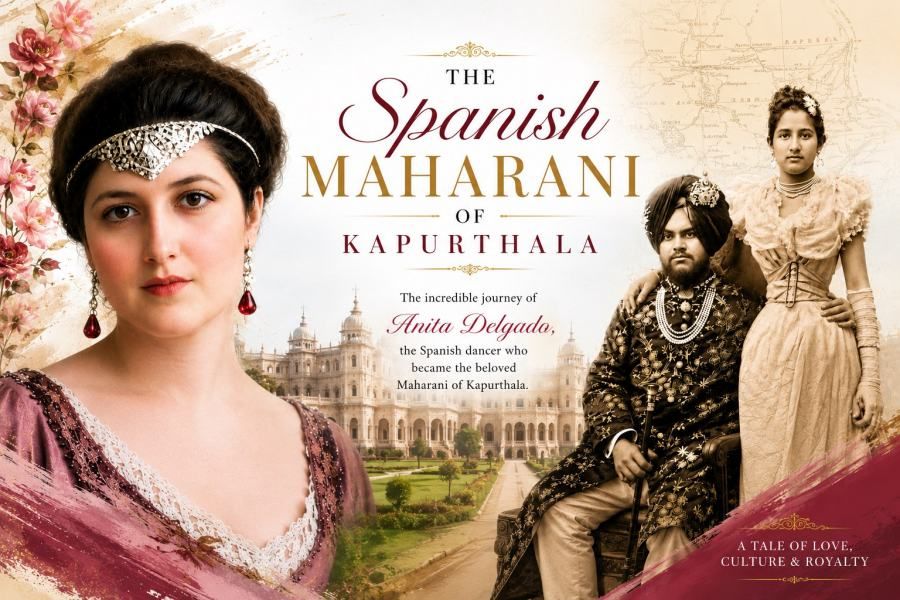
More than a queen, Maharani Prem Kaur became the living symbol of a remarkable bond between Spain and Kapurthala.
A Fairytale That Defied History
History is filled with extraordinary love stories, but few are as captivating as that of Anita Delgado, the Spanish teenager who crossed continents to become Maharani Prem Kaur of Kapurthala.
Imagine a young Flamenco dancer from the narrow streets of Málaga suddenly finding herself surrounded by glittering palaces, priceless jewels, and royal ceremonies in Punjab. It sounds like the plot of a romantic novel, yet it is one of the most fascinating true stories in Indian royal history.
Her journey was not merely about love. It was about ambition, transformation, cultural exchange, and ultimately, independence. Anita became a symbol of how destiny can rewrite even the most ordinary beginnings.
Growing Up in the Shadows of Poverty
Anita Delgado Briones was born in 1890 in the beautiful Spanish coastal city of Málaga. Her family lived modestly. Her father owned a small café called La Castaña, where customers enjoyed coffee while informal gambling provided an important source of income.
Life changed overnight when Spain outlawed gambling. The family’s earnings disappeared, forcing them to leave Málaga in search of a better future.
Madrid welcomed them with opportunities—but also harsh realities. Poverty became their constant companion. Food was scarce, money even scarcer, and every day was a struggle.
Yet even during these difficult years, fate quietly prepared Anita for an extraordinary future.
When Flamenco Became a Lifeline
Unable to afford formal dance education, Anita and her sister Victoria were fortunate to have a compassionate neighbour who taught them Flamenco free of charge. What began as a hobby soon became the family’s only means of survival.
The sisters started performing together under the stage name Las Hermanas Camelias—The Camelia Sisters. Their passionate performances eventually earned them a place at Madrid’s prestigious Kursaal Frontón, a fashionable venue frequented by diplomats, aristocrats, artists, and wealthy travellers from around the world.
Little did Anita know that one performance would change her life forever.
A Maharaja Falls in Love
The year was 1906.
Madrid was celebrating the wedding festivities of King Alfonso XIII, attracting royalty and nobility from across Europe. Among the distinguished guests was Maharaja Jagatjit Singh of Kapurthala, one of India’s wealthiest and most cosmopolitan rulers. Educated, multilingual, and deeply fascinated by European culture, the Maharaja was unlike many of his contemporaries.
One evening, he attended the Kursaal Frontón. As Anita danced across the stage, the Maharaja was mesmerised. Her expressive eyes, graceful movements, and youthful charm left an unforgettable impression.
For him, it was love at first sight.
An Unlikely Courtship
The very next morning, a magnificent silver carriage stopped outside Anita’s modest home.
Inside was Maharaja Jagatjit Singh. The contrast could not have been greater—a powerful Indian ruler standing at the doorstep of a poor Spanish family. The Maharaja openly declared his affection and began showering Anita with gifts, flowers, and luxurious dinners.
One famous incident perfectly captures Anita’s innocence. During an elegant dinner, she reportedly drank the warm water served in a finger bowl, unaware of its purpose. Rather than embarrassing her, the story highlighted how completely untouched she was by aristocratic life.
Her family, however, remained unconvinced. Marrying a foreign, non-Christian ruler seemed unimaginable. Eventually, the Maharaja’s assurance that he would provide lifelong financial security persuaded them to give their blessing.
Transforming a Dancer into a Queen
Marriage to an Indian Maharaja required far more than romance. Before Anita Delgado could enter the royal household of Kapurthala, she had to be transformed into a queen worthy of one of India’s most cosmopolitan princely states.

Determined that his future wife would be prepared for life at an international royal court, Maharaja Jagatjit Singh arranged for Anita to live at his magnificent Paris residence under the supervision of experienced tutors and royal companions. There, she underwent months of intensive education designed to prepare her for the responsibilities of royalty.
Her training extended far beyond language lessons. Anita devoted herself to mastering French and English, enabling her to converse effortlessly with European aristocrats, diplomats, and distinguished guests who frequently visited the Maharaja’s residences. She was also introduced to the customs, etiquette, and ceremonial traditions of both European courts and Indian royalty, learning everything from formal dining etiquette and state receptions to the protocols expected during royal ceremonies.
Physical refinement formed another important part of her education. She took lessons in horse riding, tennis, ice skating, ballroom dancing, and graceful deportment. She learned how to dress with royal elegance, select appropriate jewellery for different occasions, and carry herself with the dignity expected of a Maharani. Remarkably, she also learned to drive and obtained a driving licence—an extraordinary accomplishment for a young woman in the early twentieth century, when female motorists were still a rarity in Europe. With poise, intelligence, and confidence, Anita Delgado was now ready to become Maharani Prem Kaur of Kapurthala—a woman who would bridge two continents, two cultures, and two royal worlds, becoming one of the most fascinating queens in the history of princely India.
The Spanish Queen of Punjab
On 28 January 1908, Anita married Maharaja Jagatjit Singh in a grand Sikh ceremony and received her new name:
Maharani Prem Kaur.
Her new home was unlike anything she had imagined.
Kapurthala was often called the “Paris of Punjab.” The Maharaja had filled his kingdom with French-inspired architecture, magnificent gardens, imported furniture, crystal chandeliers, and European artwork.
The famous Jagatjit Palace echoed the grandeur of France’s royal residences. French chefs prepared elaborate meals, while musicians and artists entertained distinguished guests from around the world.
For Anita, moving from Madrid to Kapurthala felt less like entering a foreign land and more like stepping into a European palace placed in the heart of India. The couple had a son, Prince Ajit Singh of Kapurthala.
A Royal Celebrity
Maharani Prem Kaur quickly became one of the most talked-about royal women of her era. Newspapers across Europe eagerly followed her life. Indian royalty admired her elegance, intelligence, and effortless charm.
Yet acceptance was not universal.
Many British officials serving in colonial India viewed her background as unacceptable. To them, she was still a former nightclub dancer rather than a legitimate queen.
Despite these social prejudices, Anita maintained her dignity and continued to represent Kapurthala with remarkable grace.
One unforgettable story involves the Nizam of Hyderabad, who was reportedly enchanted by her beauty. During a royal dinner, diamonds mysteriously appeared inside her folded napkin. Excitement soon turned into amusement when the glittering stones were later discovered to be imitation gems.
The incident became one of the many colourful anecdotes surrounding the glamorous Maharani.
When the Fairytale Began to Fade
No fairytale remains untouched by reality. After nearly two decades together, cracks appeared in the royal marriage. The Maharaja’s affection for European women continued, while Anita increasingly valued her own freedom and independence. The actual reason behind this relationship breakup is unclear.
Their disagreements eventually exploded during a stay at London’s famous Savoy Hotel in 1925. The argument became so intense that Mohammad Ali Jinnah, then a close friend of the Maharaja, stepped in to mediate between the couple.
Following lengthy negotiations, the marriage came to an end. Anita received a generous financial settlement that allowed her to maintain a royal lifestyle without remaining in the marriage.
Royal Heritage of Kapurthala
More than a century after his reign, Maharaja Jagatjit Singh (1872–1949) remains one of the most progressive and internationally admired rulers of princely India. A seasoned traveller, diplomat, and patron of the arts, he envisioned Kapurthala as a city where Eastern traditions met Western sophistication. His contributions extended beyond magnificent buildings—he modernised administration, promoted education, encouraged cultural exchange, and brought European influences to Punjab while preserving the state’s rich Sikh identity. His marriage to the Spanish-born Maharani Prem Kaur (Anita Delgado) added an extraordinary chapter to Kapurthala’s history, making the royal court famous across Europe.


The magnificent Jagatjit Palace, inspired by the Palace of Versailles and Château de Fontainebleau, stands as the finest example of his grand vision. The stunning Moorish Mosque, modelled after the Great Mosque of Marrakesh in Morocco, reflects the Maharaja’s appreciation for global architecture and religious harmony. The graceful Elysee Palace, with its French-inspired design, further showcases the cosmopolitan character of Kapurthala, while the beautifully built State Gurdwara symbolises the Sikh faith and the royal family’s devotion to their spiritual heritage.
Life Beyond the Palace
After leaving India, Anita settled once again in Europe. She lived a lavish life travelling between Europe and the palaces of Punjab, and later penned her experiences in a book titled “Impresiones de mis viajes a las Indias”.
She divided her time between Paris, Biarritz, and Madrid, living comfortably and retaining many of the jewels and treasures she had acquired during her royal years. Stories circulated that she dined with solid-gold cutlery and entertained distinguished guests with memories of her extraordinary life in India.
Despite leaving Kapurthala, the experience remained a defining part of her identity. She died in Madrid in 1962, closing one of history’s most remarkable chapters.
A Secret That Emerged Decades Later
For many years, Anita’s story seemed destined to fade into history. Anita’s family had ended, or so it was believed until 2009, when Lebanese-American journalist Maha Akhtar published her bestselling book The Maharani’s Hidden Granddaughter. It revealed a stunning family secret.
She disclosed that she (Maha Akhtar) was Anita Delgado’s granddaughter through Anita’s son, Prince Ajit Singh, with Lebanese-born Zahra Ajami. Ajit Singh never married and died in New Delhi in 1984. Family accounts say he was once in love with an Argentinian woman, but she died before they could be engaged.
Though often overshadowed by the romantic story of Maharaja Jagatjit Singh and Anita Delgado, Prince Ajit Singh occupies a unique place in history as the heir of one of the most remarkable cross-cultural marriages of the princely era—a life that bridged Spain, India, and Europe while remaining largely outside the spotlight.
Prince Ajit Singh of Kapurthala lived in England, France, and Argentina as he grew up, went to school, and worked. After his parents separated around 1925, his mother moved back to Europe. Prince Ajit split his life between elite European institutions and his diplomatic postings abroad.

The revelation attracted worldwide attention and introduced a new generation to the extraordinary life of the Spanish Maharani.
Among the treasured family heirlooms was an amethyst ring that had once belonged to Anita herself—a tangible reminder of a woman whose life bridged two continents, two cultures, and two civilisations.
A Legacy Beyond Love
Anita Delgado’s story is far more than a royal romance.
It is the tale of resilience over poverty, courage over convention, and transformation beyond imagination. She proved that birth does not determine destiny. A girl who once danced to feed her family became one of India’s most glamorous queens, leaving behind a legacy that continues to inspire historians, writers, and travellers alike.
More than a century later, the legend of Maharani Prem Kaur still reminds us that history’s most unforgettable stories are often those that seem impossible—until they happen.
Chasing Clouds: A Beautiful Journey from Sacred Ganga to Mountains

Chasing Clouds: A beautiful journey from Haridwar to Mussoorie and Landour, exploring monsoon mountains, misty roads, nature, love and unforgettable moments.


No Comment