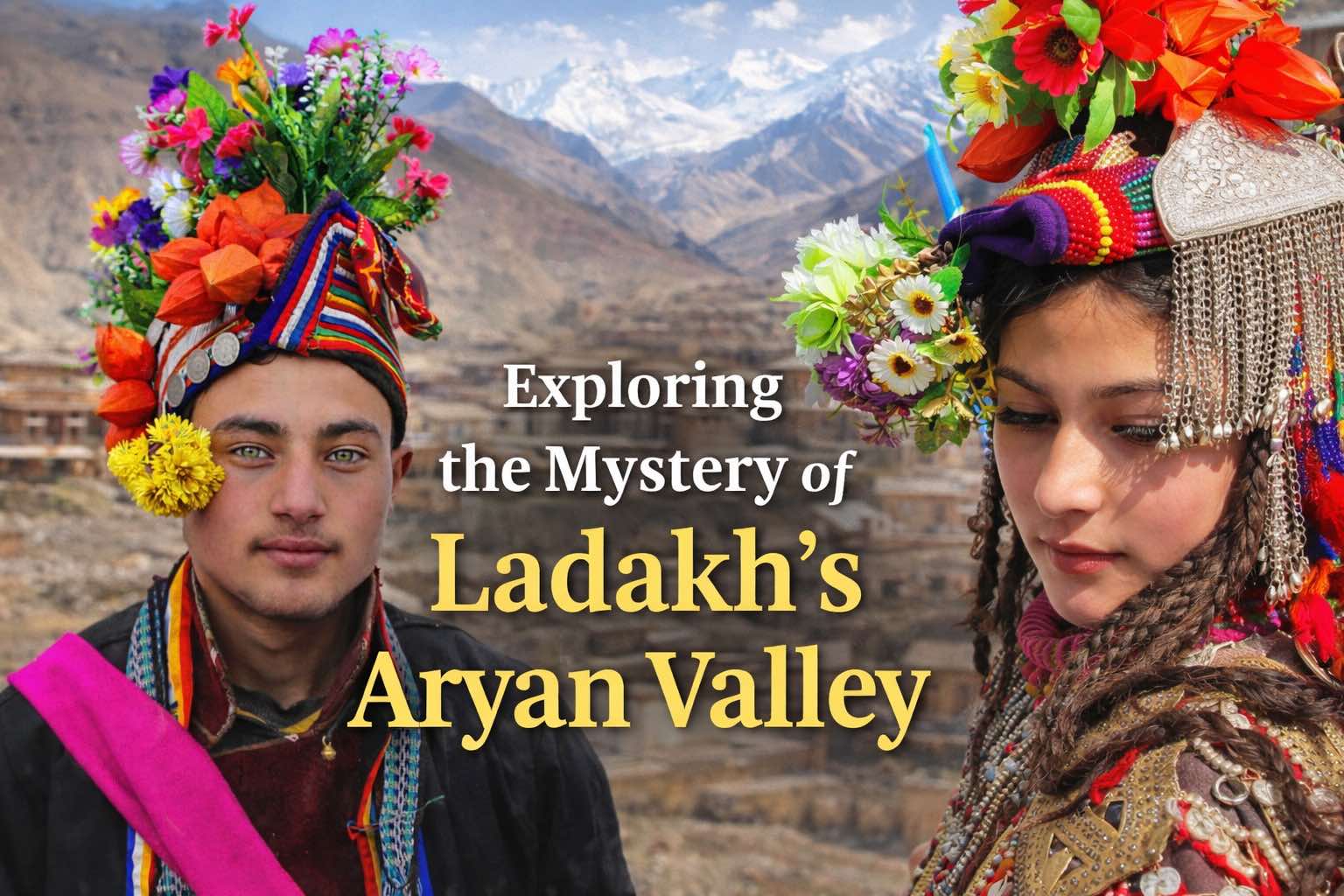
High in the dramatic, sun-washed landscapes of Ladakh, along the ancient flow of the Indus (Sindhu) River, lies a set of villages that feel almost detached from the rest of the Himalayan world. Travellers moving through Ladakh usually notice the Mongolian-influenced facial features common across the region. Yet in a small cluster of villages—Dah, Hanu, Darchik, and Garkon—the people appear strikingly different.
These villages are home to the Brokpas (or Drogpa) community, a group that has fascinated historians, anthropologists, and curious travellers for decades. Their unusual physical features and unique cultural traditions have led to one of the most intriguing narratives of the Himalayas: the belief that these villagers represent the last surviving “pure Aryans.”
But is this claim rooted in history, or is it a myth strengthened by tourism and folklore? The story of Ladakh’s Aryan Valley lies somewhere between legend, identity, and modern curiosity.
A Distinct Community in the Indus Valley
The Brokpas people live at an altitude of nearly 3,000 meters, surrounded by barren mountains, narrow valleys, and the timeless flow of the Indus River. What immediately catches a visitor’s attention is their appearance. Many members of the community are tall, sharp-featured, and fair-complexioned, with lighter eye colours such as blue or green—traits uncommon in the surrounding Himalayan population.
Beyond physical appearance, the Brokpas possess a rich cultural identity that sets them apart. Their traditions, dress, and rituals reflect centuries of isolation and self-preservation. Women wear elaborate floral headdresses called tepi, decorated with berries, coins, and colourful ornaments. These headdresses, combined with traditional robes and jewellery, create a vibrant visual identity that is instantly recognisable.

Men typically wear maroon or dark robes with waistbands, and community life continues to revolve around agriculture, livestock, and local festivals.
Unlike much of Ladakh, where Buddhism and Islam dominate religious life, the Brokpas community follows distinct indigenous customs and beliefs that blend animism, ancient traditions, and local spirituality.
Isolation and the Preservation of Identity
One of the defining aspects of the Brokpas culture is endogamy—the tradition of marrying within the community. For generations, marriages were encouraged only among people from the same cluster of villages. This practice was believed to preserve their cultural identity and, according to local belief, maintain the purity of their lineage.
Dietary customs also reflect this cultural distinctiveness. Traditionally, the community avoids certain foods such as cow’s milk and eggs, while sheep and goats hold particular cultural importance. These customs reinforce a shared identity that has been preserved through centuries of geographical isolation.
In many ways, the Brokpas villages function like a living cultural island within Ladakh.
The Legend of Alexander’s Soldiers
The most famous claim about the Brokpas people is that they are descendants of Alexander the Great’s soldiers.
According to a popular legend, when Alexander’s army advanced into the Indian subcontinent in the 4th century BCE, some soldiers remained behind during the retreat. Over time, these soldiers allegedly settled in the remote valleys of the Indus and integrated with the local population.
This narrative gained popularity because of the Brokpas’ distinctive physical features and the region’s historical position along ancient trade and migration routes.
The word “Aryan”, often associated with this narrative, originally meant “noble” in ancient Indo-Iranian languages. However, in the 19th century, European scholars misunderstood references in the Rig Veda and turned the term into a racial category. Later, extremist ideologies—most notoriously the racial theories of Nazi Germany—misused the concept of Aryans as a supposedly superior race.
The Brokpas story, therefore, became entangled with these historical misinterpretations.
The Controversial “Pregnancy Tourism” Story
Over the past two decades, a controversial narrative has occasionally surfaced in media reports: the phenomenon known as “pregnancy tourism.”
According to some stories, a small number of European women—particularly from Germany—have travelled to these villages hoping to conceive a child with a Brokpas man, believing that the community represents a preserved Aryan lineage.
Some researchers and local guides have mentioned isolated cases where tourists formed relationships with locals during extended visits. In certain instances, gifts or financial support were reportedly offered.
However, it is important to note that such stories remain rare, poorly documented, and often exaggerated by media coverage. Most visitors who travel to Aryan Valley are simply interested in experiencing the culture, landscapes, and unique traditions of the region.
What Science Actually Says
When modern genetics enters the discussion, the idea of a “pure Aryan race” quickly collapses.
Most historians and geneticists agree that Aryan originally referred to a linguistic and cultural group, not a biological race. Human populations have mixed continuously through migration and interaction for thousands of years.
So far, no scientific DNA evidence proves that the Brokpas are descendants of Alexander’s soldiers or that they represent a genetically “pure” population.
Studies on human migration suggest that while various groups moved through Central Asia and South Asia over millennia, local populations have always mixed with each other. The genetic history of the Indian subcontinent is complex and interconnected.
For many scholars, the Aryan Valley story is less about race and more about cultural preservation combined with tourism narratives.
Myth, Identity, and Tourism
Today, the label “Aryan Valley” has become a powerful tourism brand. Travellers visit these villages to photograph traditional costumes, experience local festivals, and stay in village homestays.
Some critics argue that the “last pure Aryans” label functions as a tourism marketing strategy—a unique identity that attracts international curiosity.
Yet for the Brokpas people themselves, the story represents something deeper than marketing. It reflects a sense of pride in their heritage, traditions, and distinct cultural identity.
A Valley Between Legend and Reality
Whether the Brokpas people are descendants of ancient Indo-Iranian tribes, migrants from Central Asia, or simply a community shaped by centuries of isolation, one thing is certain: their culture is extraordinary.
The Aryan Valley of Ladakh remains a fascinating intersection of history, myth, anthropology, and tourism. As roads improve and visitors increase, these remote villages are slowly entering the global spotlight.
The challenge ahead lies in preserving the authenticity of the Brokpas culture while navigating the growing curiosity of the outside world.
For travellers, historians, and writers alike, Aryan Valley remains one of the most intriguing cultural landscapes in the Himalayas. In this place, legend and reality continue to coexist in the shadow of the mountains.
William Wordsworth’s Timeless Lesson for a Noisy World

Explore William Wordsworth’s insight on wisdom, humility, and the beauty of simple living in a rushed world.


No Comment