Updated on February 15th, 2026
Where Sikh Faith Breathes in Silence and Song
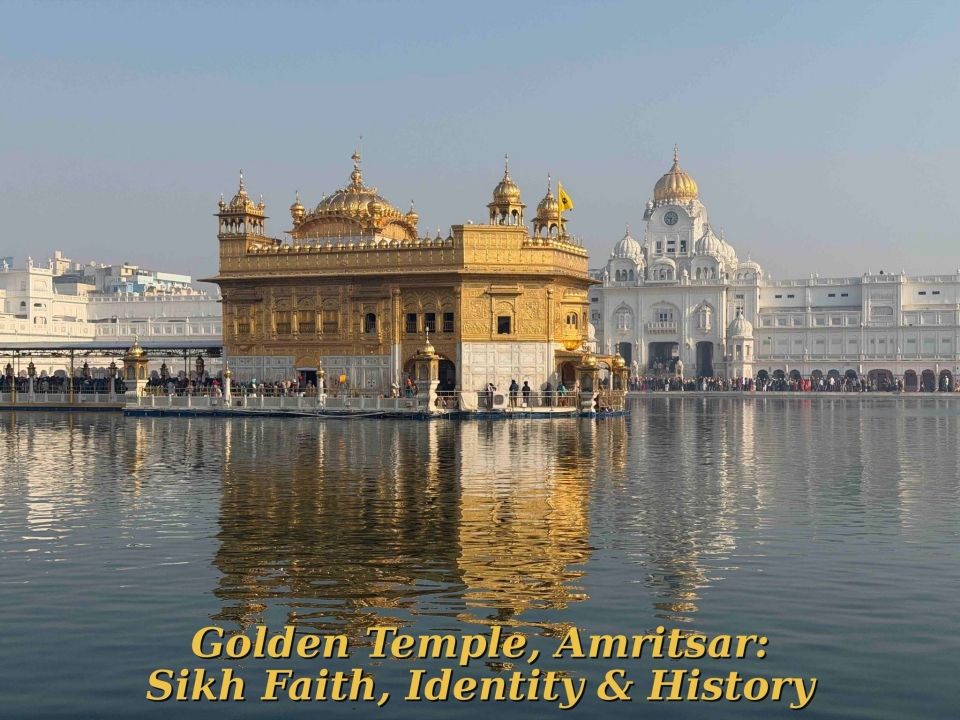
There are places in the world that do not merely exist as monuments; they exist as living emotions. Darbar Sahib, Amritsar, widely known as the Golden Temple, is one such sacred space. Situated in the heart of Amritsar, Punjab, Darbar Sahib is not only the most revered shrine in Sikhism, but also one of the most spiritually magnetic places on earth. People often come to see its golden reflection in the holy sarovar, yet what truly moves them is something deeper: the atmosphere of humility, devotion, equality, and peace that seems to flow through every step.
For Sikhs across the globe, Darbar Sahib is far more than a religious site. It is a symbol of Sikh identity itself—an identity shaped by devotion to the One, service to humanity, resistance against injustice, and a spiritual discipline that remains grounded in everyday life.
Darbar Sahib: The Spiritual Centre of Sikhism
In Sikh tradition, Darbar Sahib is referred to as the “Harimandir Sahib,” meaning the “Temple of God.” Yet, Sikhs lovingly call it “Darbar Sahib,” which conveys the idea of the Divine Court—where one comes not to display status, but to surrender ego.
The spiritual power of Darbar Sahib is rooted in its purpose. Sikhism was never intended to create distance between God and the world. Instead, it was meant to bring the Divine into the centre of daily life. Darbar Sahib represents this principle in physical form. It is open to everyone—irrespective of religion, caste, gender, nationality, or social background. This openness is not symbolic; it is lived, practised, and protected as a sacred obligation.
The History: From Guru Arjan Dev Ji to a Global Symbol
The foundations of Darbar Sahib were laid under the vision of the fifth Sikh Guru, Guru Arjan Dev Ji, in the late 16th century. The story is deeply meaningful because it reflects the values Sikhism sought to establish in society. It is widely recorded that Guru Arjan Dev Ji invited Mian Mir, a respected Sufi saint, to lay the foundation stone. Whether one reads this as a historical fact or a cherished tradition, the message is unmistakable: Sikh spirituality recognises the light of the Divine beyond boundaries.
Guru Arjan Dev Ji also compiled the Adi Granth, the scripture that later became Guru Granth Sahib, and installed it at Harimandir Sahib in 1604. This moment was not merely ceremonial. It defined Sikh identity permanently. The Sikh community was anchored in a spiritual text, not in kingship, wealth, or hereditary priesthood. The Guru’s authority was the authority of truth, not the authority of power.
Architecture as Philosophy: A Temple Built to Teach
The Golden Temple’s architecture is not just beautiful; it is profoundly symbolic. The shrine is built lower than the surrounding land, and devotees descend steps to reach it. This is a silent lesson in humility. Before one can enter the Divine Court, one must bow physically and inwardly.


Equally powerful is the fact that Darbar Sahib has four entrances, facing all directions. This design represents openness and inclusivity. It communicates that the Divine belongs to all and that the Sikh path welcomes all seekers.
The sacred sarovar (pool of nectar) surrounding the shrine is not only visually stunning but spiritually significant. Bathing in it is traditionally associated with purification, but Sikh philosophy reminds us that the greatest purification is inner transformation—removing ego, anger, greed, attachment, and pride.
Faith in Practice: Kirtan, Simran, and the Living Presence of the Guru
At Darbar Sahib, faith is not expressed solely through silence. It is expressed through the continuous flow of kirtan—the singing of Gurbani. The sound of sacred verses does something extraordinary: it calms the mind while strengthening the spirit. Even those who do not understand Punjabi often feel emotionally moved, because Gurbani carries a rhythm that speaks directly to the human heart.
The presence of Guru Granth Sahib Ji at Darbar Sahib is central. In Sikhism, the Guru is not a person today; the Guru is the Shabad, the Divine Word. The scripture is treated with reverence, not as a book, but as the living Guru. This is one of the most defining features of Sikh identity, and Darbar Sahib stands as the most prominent home of that living spiritual authority.
Langar: The Most Powerful Expression of Equality
If one were to ask what truly makes Darbar Sahib the heart of Sikh identity, the answer would not only be the golden dome or the sacred hymns. It would be Langar—the community kitchen that serves free food to everyone.
Langar is not charity. It is spiritual equality in action. At Darbar Sahib, thousands of people eat together daily, sitting in rows on the floor, regardless of wealth or social position. This practice challenges the oldest human disease: discrimination. It teaches that no one is higher and no one is lower in the presence of the Divine.
In a world still divided by class, religion, and prejudice, the Langar of Darbar Sahib remains one of humanity’s greatest living lessons.
Darbar Sahib and Sikh Identity: Courage, Memory, and Resilience
Darbar Sahib is also deeply tied to the Sikh history of resilience. It has witnessed periods of peace and profound tragedy. The Sikh community has defended it, rebuilt it, and returned to it again and again—not as an act of politics, but as an act of faith.
For Sikhs, the Golden Temple stands as a reminder that spirituality is not weakness. Sikhism teaches that devotion and courage must walk together. A Sikh bows in humility before the Divine, but stands in strength before injustice. Darbar Sahib symbolises both these qualities: inner surrender and outer fearlessness.
Why Darbar Sahib Still Matters Today
In modern times, Darbar Sahib continues to attract millions of visitors each year, including non-Sikhs who come seeking peace, healing, and inspiration. Its relevance has only grown stronger. In a world full of noise, competition, and division, it offers quiet, service, and equality.And in a world full of anxiety, it offers the steady reassurance of Naam—Divine remembrance.
For Sikh identity, Darbar Sahib remains a spiritual home, a moral compass, and a symbol of collective belonging. It is a reminder that Sikhism is not simply a religion of rituals. It is a way of life built on truth, humility, honest work, sharing, and fearless compassion.
The Golden Temple as a Living Message
Darbar Sahib is not sacred because it is golden. It is sacred because it is alive—with prayer, with service, with remembrance, and with humanity. It is a place where the poorest can eat without shame, where the weary can rest without being questioned, and where the proud are gently reminded to bow.
For Sikhs, Darbar Sahib is the heartbeat of faith. For the world, it is a rare example of spirituality practised as equality. And for every visitor, it offers something that cannot be bought or forced: the feeling of peace that arrives when ego falls silent.
References
Sri Guru Granth Sahib Ji (Guru Granth Sahib)
Khushwant Singh, A History of the Sikhs
W.H. McLeod, Sikhism
J.S. Grewal, The Sikhs of the Punjab
Pashaura Singh & Louis E. Fenech (eds.), The Oxford Handbook of Sikh Studies
Master’s in Tourism and Recreation (M.A.) at EIIET Berlin

Master’s in Tourism and Recreation program, offered by the esteemed Institute of Berlin (EIIET) in partnership with the University of Tourism and Hotel Management (WSTiH). This intensive two-year postgraduate course meticulously equips ambitious students with the advanced skills and knowledge to position themselves as financial and strategic leaders in the ever-evolving tourism industry.


No Comment