Updated on February 6th, 2026
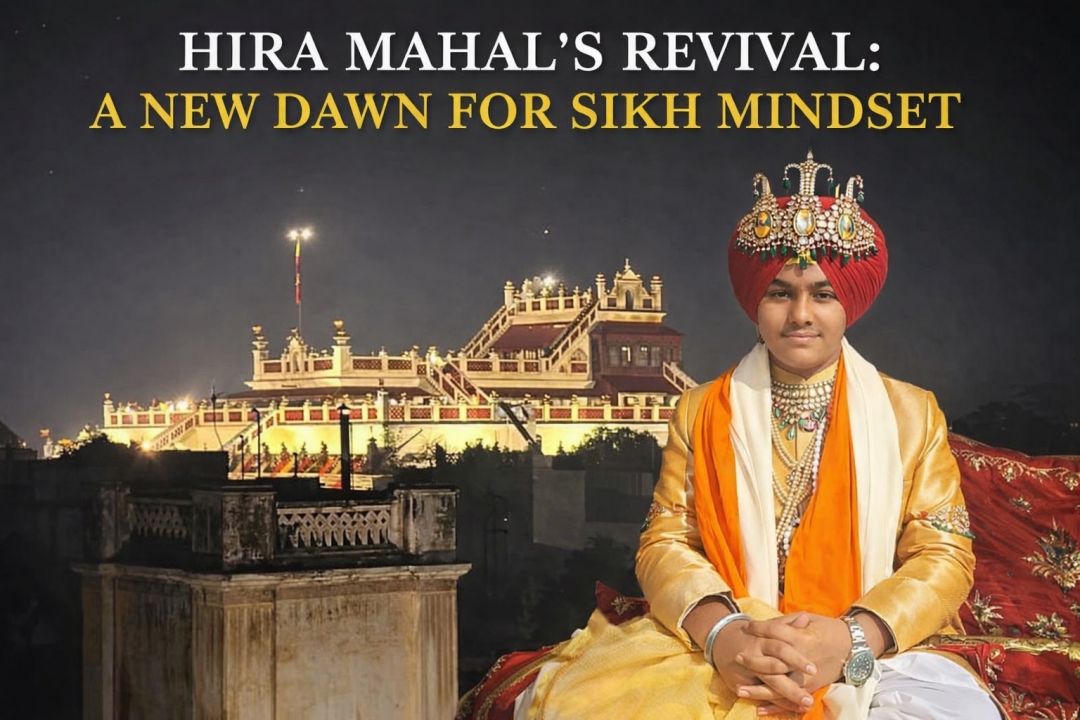
There are moments in history when the past does not return as nostalgia, but as a living force. The recent revival of the royal tradition at Nabha—through the ceremonial dastarbandi of a young, Udaypratap Singh—feels like one such moment. Not because Punjab is seeking kingdoms again, but because Punjab is remembering itself again.
In an age where identity is often reduced to slogans and heritage becomes a photo-op, this story carries an unusually pure emotional weight. It is not a political comeback. It is not a power demand. It is something far deeper: a young boy awakening the memory of his ancestors, and through that, awakening a spark of Sikh confidence in thousands of hearts watching.
A Child Who Refused to Forget
The most striking part of this entire episode is not the ceremony itself. It is the mindset behind it.
Udaypratap Singh is said to be barely 13 years old. Yet, his imagination seems to have carried the gravity of centuries. In his childhood, he would play on the rooftop, raising a small Nishan Sahib as if it was the most natural thing in the world. He would call himself a king in innocence, but that innocence carried a strange truth: the bloodline he belonged to was not ordinary. It was rooted in the royal house of Nabha, a princely state that once stood tall in the Sikh political landscape.
Many families lose their past when they move away from it. Generations shift to cities. Memories thin out. The modern world convinces heirs that history is irrelevant. And in this case, too, the sixth generation of the Nabha royal family had been living in Delhi, far removed from the physical land that once defined them.
But this boy, through sheer insistence, pulled his family back. He asked them to visit Nabha. He wanted to see the Hira Mahal, the historic palace connected to Maharaja Ripudaman Singh. And once the family saw what had been lost, they began the legal and restorative process to reclaim what was rightfully theirs.
Nabha: A Land at the Heart of Punjab
Nabha holds an almost symbolic geography. Many narratives describe the town as a “navel” between Delhi and Lahore—midway between two historic power centres. Local tradition also links “Nabha” to “naab” (cartwheel hub), suggesting craftsmanship and centrality.
Whether one accepts one theory or the other, the truth remains: Nabha was never a minor footnote. It was one of the prominent Phulkian states of Punjab, alongside Patiala and Jind. These states carried Sikh royal identity through a period when Punjab was politically alive, culturally confident, and strategically significant.
And among Nabha’s rulers, Maharaja Ripudaman Singh remains one of the most remarkable.
Maharaja Ripudaman Singh: The Spirit of Defiance
Ripudaman Singh is remembered for his independent streak and for refusing to bow blindly to British authority. Historical records show that British authorities eventually forced him to abdicate in 1923 and exiled him. His story stands as a reminder of how colonial rule did not only conquer lands—it systematically dismantled local sovereignties, silenced dissenting rulers, and rewrote Punjab’s confidence.
This is why the revival of Nabha’s tradition does not feel like a royal celebration alone. It feels like a moral statement. It reminds us that Punjab once had rulers who were not puppets, and that Sikh leadership once carried political spine.
And perhaps, that spine can return—not through thrones, but through mindset.
The Ceremony: Not a Crown, But a Continuity
After legal restoration and cleaning of the palace, and now on 2nd February, the ceremony of Dastarbandi at Hira Mahal became a symbol. The old tradition, dormant for more than a century, breathed again.
For those who witnessed it, it did not feel like theatre. It felt like time folding back.
The young Yovraj, standing where his ancestors once stood, created an emotional bridge between eras. It was as if Punjab, for a moment, stepped out of modern outlook and entered the dignity of its own history.
The real meaning of this event is not that a child became a king. The real meaning is that a child became aware.
And awareness is the first step of revival.
Hope as a Sikh Mindset
This is where the Sikh mindset becomes central.
Sikh history has never been about helplessness. It has always been about standing upright—Chardi Kala, the unbroken spirit. Even in the darkest times, Sikh philosophy refuses defeat as a permanent state. It teaches that dignity is not gifted by rulers; it is earned by character.
When a young boy insists on reclaiming his heritage, it becomes a metaphor for an entire community. It tells us something simple but powerful: “We do not have to remain disconnected from who we were.”
For decades, Punjabis have been taught to feel small. Either by colonial narratives or by the modern social and political setup. Many have grown up knowing only fragments of their legacy: a few stories of Maharaja Ranjit Singh, a few lines about the Khalsa, a few names of princely states. But the emotional ownership has faded.
This story returns that ownership.
It reminds us that Punjabis were not born to be servants of history. Punjabis were creators of history. Sikh leadership was once a disciplined political force. Maharaja Ranjit Singh built one of the subcontinent’s strongest indigenous empires, skillfully holding the British at the Sutlej for years through strategy and diplomacy.
A Revival That Can Inspire a Generation
Some people even whisper that Udaypratap Singh is the reincarnation of Maharaja Ripudaman Singh. Whether one believes in such ideas or not, the symbolic truth is undeniable: the spirit of Ripudaman’s defiance has returned in a new form.
And perhaps that is how history works. Not through literal rebirth, but through the rebirth of courage.
In the end, the Nabha story is not about royalty. It is about remembrance.
It is about a generation that is tired, scattered, and often confused—finding a new reason to feel proud. It is also about the Sikh mindset shifting from complaint to confidence. It is about heritage becoming hope.
And if a 13-year-old child can look at a forgotten palace and say, “This is ours,” then surely an entire community can look at its own forgotten strength and say the same.
Because the future does not belong to those who forget.
The future belongs to those who remember—and rise.
William Wordsworth’s Timeless Lesson for a Noisy World

Explore William Wordsworth’s insight on wisdom, humility, and the beauty of simple living in a rushed world.


No Comment