Updated on March 5th, 2026
Understanding the Two Pillars of Iran’s Islamic Republic
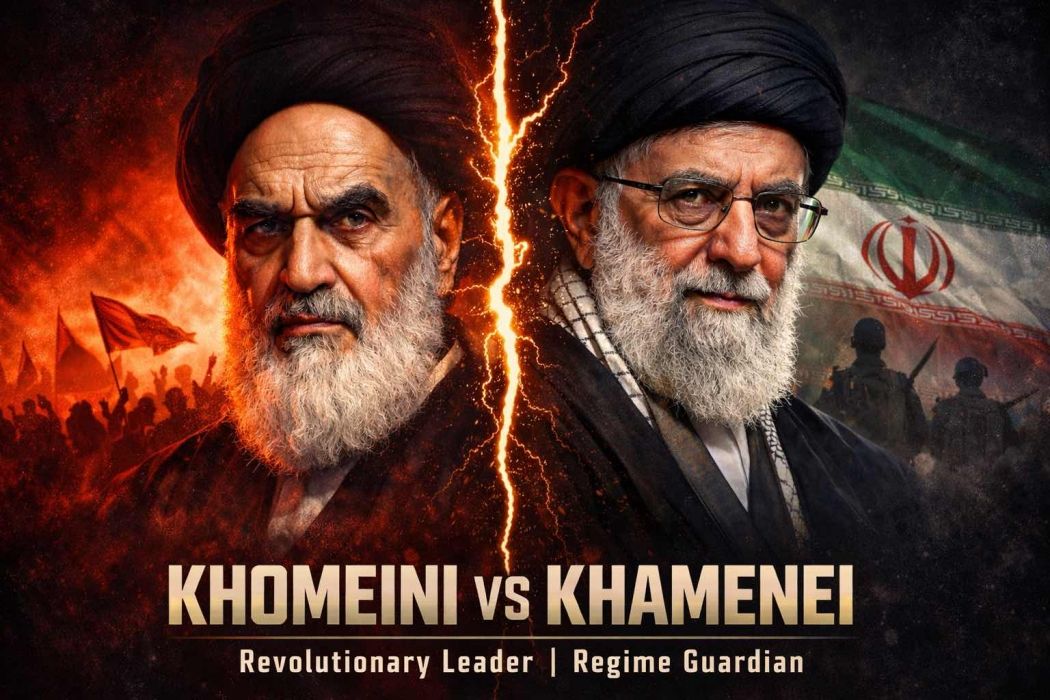
History often remembers nations through the contrasting roles of their leaders. Some create revolutions; others ensure their survival. If Ayatollah Ruhollah Khomeini is remembered as the architect who created Iran’s Islamic Republic in 1979, then Ayatollah Ali Khamenei may ultimately be remembered as the leader who prevented its collapse during one of the most turbulent eras in modern Middle Eastern history.
The story of modern Iran is, therefore, not a single revolution but a long struggle between ideology and survival.
The Revolutionary Vision of Khomeini
The Islamic Republic of Iran was born out of the 1979 Iranian Revolution, when Ayatollah Khomeini overthrew the monarchy of Shah Mohammad Reza Pahlavi and replaced it with a system based on Velayat-e-Faqih — governance under Islamic juristic authority. The Iranian Revolution of 1979 was one of the most dramatic political upheavals of the twentieth century. Mass protests through 1978 paralysed the country, forcing Shah Mohammad Reza Pahlavi to flee on January 16, 1979. Khomeini returned to Iran, and within ten days, the imperial government had collapsed. A new constitution, drafted and ratified by the end of the year, and Khomeini was now the first Supreme Leader (Rahbar).
Khomeini was a charismatic revolutionary figure whose authority rested on moral legitimacy and religious symbolism. He mobilised millions through anti-imperialist rhetoric, opposition to Western influence, and promises of Islamic justice. During his regime, many major things happened. Iran Iraq war is major thing of his period. Khomeini refused ceasefire offers for years. His 1988 fatwa on the massacre of political prisoners and his 1989 fatwa ordering the death of novelist Salman Rushdie illustrated the reach of his authority.
Khomeini died on June 3, 1989, triggering mass grief and a genuine constitutional crisis. This was the moment when history handed responsibility to Ali Khamenei.
An Unexpected Successor
When Khamenei became Supreme Leader in 1989, many observers doubted his suitability. Unlike Khomeini, he lacked senior clerical rank and revolutionary charisma. In fact, Iran’s constitution had to be amended to allow his appointment as Supreme Leader.
Yet leadership in post-revolutionary states often depends less on inspiration and more on consolidation.
Khamenei inherited a fragile political order transitioning from a revolutionary regime to an institutional framework. His central challenge was simple but immense: transform a revolutionary setup into a durable state.
From Revolution to System
Over nearly four decades, Khamenei gradually reshaped Iran’s power structure into a tightly interconnected system of religious authority, military strength, and bureaucratic governance.
Analysts note that he expanded the role of institutions such as the Islamic Revolutionary Guard Corps (IRGC), turning it into both a military and political pillar of regime stability. This network allowed the Islamic Republic to survive sanctions, regional wars, economic crises, and repeated domestic protests. Khamenei governed through balance—managing conservatives, reformists, clerics, and security elites while ensuring that no single faction could threaten the system itself.
The Islamic Republic gradually became less dependent on personality and more dependent on institutions.
Governing Through Crisis
Khamenei’s tenure coincided with extraordinary pressure. Iran faced decades of international sanctions, confrontation with the United States and Israel, regional proxy conflicts, and waves of internal unrest—including the Green Movement protests of 2009 and nationwide demonstrations in later years.
Each crisis tested whether the Islamic Republic would fracture.
Yet despite economic hardship and political dissent, the state structure endured. Intelligence agencies, religious councils, military institutions, and political bodies continued functioning even during severe instability.
This institutional resilience reflects Khamenei’s long-term strategy.
The Politics of Survival
Khamenei understood that survival—not expansion—was the true test of revolutionary governance.
He pursued what scholars describe as “strategic resistance”: maintaining ideological opposition to Western dominance while allowing limited political flexibility when necessary. Even reformist participation in elections was occasionally permitted to preserve legitimacy without surrendering control.
Internally, authority was centralised enough to prevent collapse but decentralised enough to continue functioning during leadership shocks.
The Ultimate Test: The Measure of Leadership After Death
The true measure of a political leader often emerges only after his departure. While a leader lives, judgments are shaped by loyalty, opposition, and the intensity of contemporary politics. But once he is gone, history begins its slower and more disciplined evaluation. It asks not what emotions surrounded him, but what remained after him.
Following the death of Ali Khamenei now in 2026, Iran entered what many observers described as its most serious leadership crisis since 1979. Predictions of instability circulated widely. Some anticipated internal fragmentation; others foresaw systemic collapse under the combined weight of sanctions, economic pressure, and generational dissent.
Yet the expected implosion did not occur. Constitutional procedures were activated. An interim leadership council assumed authority in accordance with established mechanisms. Despite uncertainty and external pressure, the state apparatus continued to function. Ministries operated. Security institutions maintained order. The broader governing framework of the Islamic Republic remained intact.
In that moment of transition, one reality became clear: the system had been structured to survive beyond the man who led it.
The Crisis That Tested the System
The true test of institutional strength often comes at the moment of succession. After Khamenei’s death, the world watched closely. Would the state unravel without its long-serving leader? Would rival factions destabilize governance?
Instead, the transition—though tense—demonstrated continuity. Constitutional mechanisms functioned. Leadership structures adapted. The absence of immediate systemic collapse indicated that authority had been embedded within institutions rather than resting solely on personality.
This was perhaps Khamenei’s most consequential legacy: transforming a movement born in charismatic revolution into a system capable of functioning beyond charismatic authority.
How History May Judge Him
Political legacies are rarely unanimous. To supporters, Khamenei defended national sovereignty and resisted external domination. To critics, his tenure symbolised centralised authority and restricted dissent. Contemporary debate will continue. War is still going on between America Isreal on one side and Iran on the other side. media reports are evaluating every moment. Governance structures remained operational even after the death of its longest-serving leader.
History is often less emotional than contemporary politics. It does not ask whether a leader was universally loved or fiercely opposed. It asks whether what he built—or preserved—survived him.
If Khomeini created the Islamic Republic, Ali Khamenei ensured that it endured long enough to become an entrenched political order. And in the measured judgment of time, survival itself may stand as his defining achievement.
References
- Encyclopaedia Britannica / Wikipedia – Ali Khamenei Profile & 1989 Leadership Transition
- AP News – Death of Iran’s Supreme Leader and Institutional Legacy
- The Guardian – Obituary: Ali Khamenei and His Rule
- Reuters – Iran Leadership Crisis and State Stability
- Media reports
Master’s in Tourism and Recreation (M.A.) at EIIET Berlin

Master’s in Tourism and Recreation program, offered by the esteemed Institute of Berlin (EIIET) in partnership with the University of Tourism and Hotel Management (WSTiH). This intensive two-year postgraduate course meticulously equips ambitious students with the advanced skills and knowledge to position themselves as financial and strategic leaders in the ever-evolving tourism industry.


No Comment