Updated on February 6th, 2026
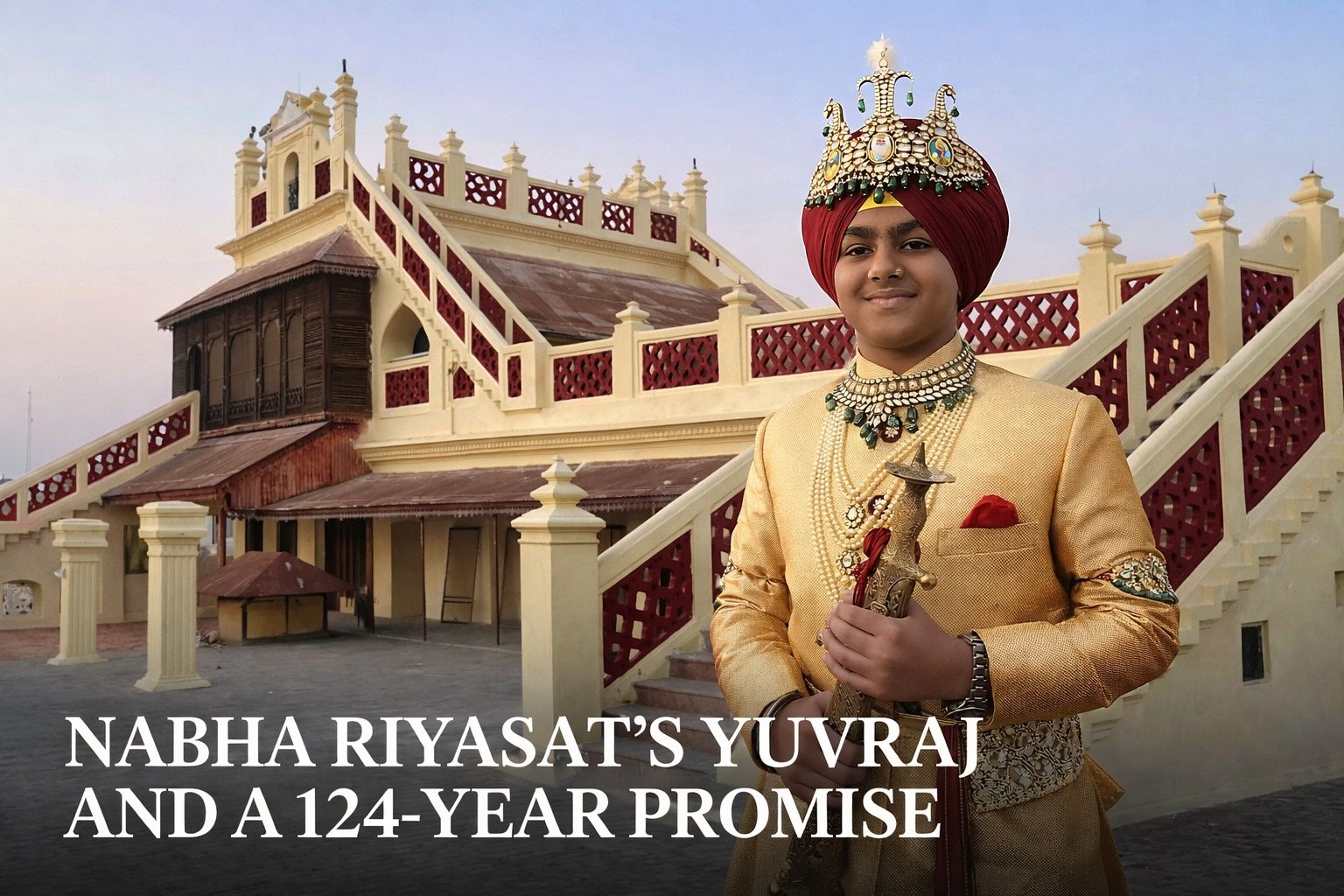
On 2nd February, the historic town of Nabha witnessed a deeply symbolic and emotionally charged event that resonated far beyond the boundaries of Punjab. After a gap of 124 years, the royal and Sikh tradition of Dastarabandi was formally performed at Hira Mahal. Abhyuday Partap Singh, great-grandson of Maharaja Ripudaman Singh of Nabha Riyasat and sixth-generation descendant of Maharaja Hira Singh of Nabha, was the centre of activity. The air in the historic town of Nabha that day resonated with Khalsa Jaikaaray—the timeless Sikh slogans of victory—transforming a ceremonial gathering into a moment of historical reawakening.
Another ceremony that attracted was the performance of a rare Ek Chaukra Akhand Path, a highly disciplined and uninterrupted recitation of the Guru Granth Sahib carried out in a single seated posture. Significantly, the royal family last conducted this exact form of Akhand Path at Nabha Fort 124 years ago, during the reign of Maharaja Hira Singh. By repeating it on 2nd February, the family deliberately undertook an act of spiritual restoration, symbolising the conscious reclaiming of a legacy that had remained dormant through colonial disruption and the years following independence. A large number of saints, religious leaders, representatives of the Shiromani Gurdwara Parbandhak Committee, Sikh intellectuals and devotees from across the country and abroad were present, and all this created a hope for reawakening traditional values.


A Brief Glimpse into Nabha’s Historical Past
Going back in history, the Nabha Riyasat arose from the Phulkian lineage, founded by the descendants of Baba Phul, a name deeply woven into Sikh political history. Its lineage traces back to Baba Phul, whose descendants went on to establish powerful Sikh states, including Patiala, Jind, and Nabha. The foundations of Nabha were laid in 1755 by Raja Hamir Singh.
Sikh tradition links the rise of the Phulkian to a blessing by Guru Hargobind Sahib, where Guru Ji said that their horses would one day drink water from both the Sutlej and the Yamuna. The vision of sovereignty carried both spiritual and moral meaning. This belief shaped the way Nabha’s rulers understood power—not merely as rule, but as duty.
Maharaja Hira Singh: The Dharmi Raja
Among Nabha’s rulers, Maharaja Hira Singh occupies a place of exceptional reverence. Ascending the throne in 1871, he became known as the Dharmi Raja—the righteous king—whose reign marked a cultural and spiritual renaissance. The very palace that hosted the recent Dastarabandi, Hira Mahal, was built by Raja Hira Singh. The palace stands as a living testament to his humane governance. During a devastating drought in Rajasthan, waves of displaced labourers arrived in Nabha. Rather than deny them refuge, the Maharaja employed them in constructing Hira Mahal, ensuring dignity through work, food, and shelter.
His patronage of Sikh scholarship was equally transformative. He supported the establishment of Khalsa College, Amritsar, and encouraged the Irish scholar Max Arthur Macauliffe to document Sikh history in English. The resulting six-volume work became a foundational text for global Sikh studies. Maharaja Hira Singh also stood firmly behind Bhai Kahn Singh Nabha, whose Mahan Kosh remains the encyclopaedic backbone of Sikh literature. His inclusive spirit extended beyond Sikhism, earning Nabha the title “Mini Kashi” through his patronage of Hindu temples alongside gurdwaras, reflecting a rare harmony of faiths.
Maharaja Ripudaman Singh and the Politics of Conscience
If Hira Singh embodied cultural patronage, his son Maharaja Ripudaman Singh (1883–1942) came to symbolise principled resistance. An independent thinker, he refused to allow British officials to conduct his coronation, insisting instead on a ceremony sanctified by the Guru Granth Sahib and led by the Panj Piare. This act alone placed him at odds with colonial authority.
His support for the Gurdwara Reform Movement and his role in advancing the Anand Marriage Act further reinforced his commitment to Sikh self-determination. British retaliation was swift. In July 1923, British authorities forcibly arrested him at Hira Mahal while he wore a black turban in protest against the Nankana Sahib massacre. This humiliation sparked the historic Jaito Morcha, a mass Sikh movement that drew participants from across India and the global Sikh diaspora, including the UK, the USA, and even China. Many laid down their lives demanding justice for their Maharaja and for Sikh autonomy. Ripudaman Singh ultimately died in exile in Kodaikanal (then Madras Presidency) under house arrest, chosen conscience over crown.
Maharaja Pratap Singh, the last ruler of the Nabha dynasty, became king at the age of eight following his father’s deposition. British authorities took him to England, where he was forced to cut his hair. He formally assumed charge of Nabha at 21 after returning to India, re-growing his kesh and restoring his Sikh identity. He ruled until 1948, when the princely states were merged into independent India.
A Child, a Calling, and an Unbroken Thread
Against this layered backdrop of faith and resistance, the recent Dastarabandi of Yuvraj Abhyuday Pratap Singh assumes a deeper meaning. Raised in modern urban settings like Delhi and Gurugram, the young prince nonetheless displayed an instinctive gravitation toward Sikh symbols from early childhood. His grandmother, Maharani Uma Singh, has recalled how he would draw the Nishan Sahib and the Khanda without any formal exposure. His insistence on keeping kesh and wearing a turban eventually drew the family back to Nabha, suggesting that heritage sometimes calls before it is taught. The family shifted from Delhi to Nabha to reside there. It was not an easy task. Claiming possession of Hira Mahal from the government took many years, and finally, the court decided in their favour.


The ceremony featured the rare performance of an Ek Chaukra Akhand Path, during which the reciter undertook a rigorous, uninterrupted reading of the Guru Granth Sahib in a single seated posture. Baba Raja Singh recited the path in one sitting. Sameway Baba Narain Singh, father of noted scholar Bhai Kahan Singh Nabha, last performed this exact form of the path at Nabha Fort 124 years ago for Maharaja Hira Singh. Its repetition was a symbolic act of reclamation, signalling continuity rather than revival alone.
Restoring Hira Mahal, Restoring Memory
The physical restoration of Hira Mahal parallels this spiritual return. Once the palace suffered years of neglect, Rani Preeti Singh carefully worked to revive it. During the restoration of Nabha Fort in Patiala district, architects found several rare artefacts and some previously unknown systems inside the fort complex. The restoration process is still going on, and it can take more time to complete. President Harjinder Singh Dhami said in the media, the palace today stands renewed as a centre of Sikh culture, with the Guru Granth Sahib respectfully enshrined and historical traditions once again finding expression.


At just twelve years old, the Yuvraj has already begun to articulate a sense of duty toward the people of Nabha. By honouring the families of Jaito Morcha martyrs at functions held in Punjab Public School, he has demonstrated that royalty, in the Sikh imagination, is inseparable from service. As his mother aptly observed, Dastarabandi is not merely about adorning a turban, but about understanding the responsibilities it carries.


Today, when History Breathes Again
In an age of rapid modernisation and cultural amnesia, the story of Nabha powerfully reminds us that heritage endures only when people live it, not merely remember it. From the prophecy of Guru Hargobind Sahib to the defiance of Maharaja Ripudaman Singh, Nabha’s history mirrors the broader Sikh journey of sovereignty, sacrifice, and spiritual integrity. The recent ceremony at Hira Mahal suggests that history has not closed its circle—it has simply waited. As the Jaikaaray echoed once more through Nabha, it felt as though the horses of prophecy had indeed returned to the Sutlej, drinking deeply from the waters of an unbroken legacy.
References
- Macauliffe, Max Arthur. The Sikh Religion: Its Gurus, Sacred Writings and Authors.
- Nabha State Gazetteers and Phulkian Misl historical records.
- Kahn Singh Nabha, Bhai. Mahan Kosh.
- Media Reports on the Dastarabandi ceremony at Hira Mahal, Nabha.
William Wordsworth’s Timeless Lesson for a Noisy World

Explore William Wordsworth’s insight on wisdom, humility, and the beauty of simple living in a rushed world.


No Comment