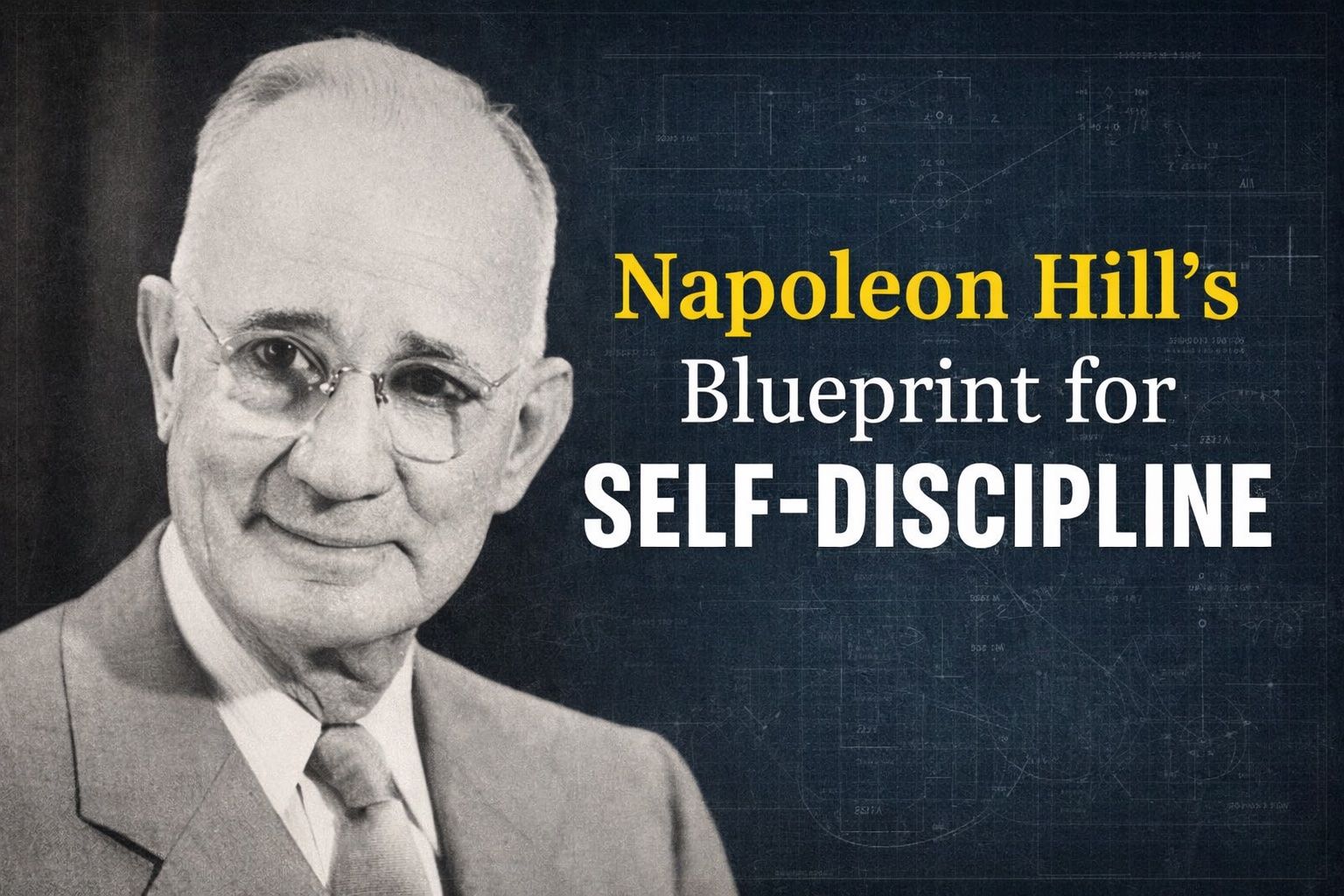
In the long marathon of life, success rarely belongs to the most gifted or the most intelligent. More often, it belongs to the most disciplined. Two people may begin from the same starting line, blessed with similar opportunities and talents, yet years later, their lives look dramatically different. One enjoys fulfilment, purpose, and achievement, while the other lives with lingering regret. The difference is not luck or fate; it is the quiet, often invisible power of self-discipline. Few thinkers have explained this truth as powerfully as Napoleon Hill, whose philosophy continues to guide millions toward purposeful success.
Hill believed that self-discipline is the foundation upon which every form of achievement is built. Without it, talent becomes wasted potential, intelligence turns into arrogance, and ambition dissolves into daydreams. With it, even ordinary abilities can produce extraordinary results.
Self-Conquest: The First Victory That Matters
In his timeless work Think and Grow Rich, Hill makes a statement that cuts straight to the heart of human struggle: “If you do not conquer self, you will be conquered by self.” This idea reframes success as an internal battle long before it becomes an external one. The greatest obstacles are not competition, economic conditions, or lack of opportunity, but uncontrolled impulses, fear, procrastination, and emotional instability.
Many people misunderstand discipline as a collection of rigid habits—waking up before sunrise, following strict routines, or denying oneself pleasure. Hill’s idea of discipline is deeper and far more demanding. It is the ability to govern thoughts, emotions, and reactions. It is choosing long-term purpose over short-term comfort, again and again, even when no one is watching.
True self-discipline reveals itself in small, ordinary moments: resisting the urge to quit when progress feels slow, focusing on meaningful work instead of distraction, and responding thoughtfully rather than reacting emotionally. Over time, these seemingly insignificant choices accumulate and shape destiny.
Discipline, Habit, and the Brain’s Hidden Power
Hill’s philosophy aligns remarkably well with modern science. Success, he insisted, is not the result of one dramatic breakthrough but of consistent, repeated actions carried out daily. Neuroscience today explains this through neuroplasticity, the brain’s ability to rewire itself based on repeated behaviors and thoughts.
When an action is repeated long enough, it forms neural pathways that eventually make the behaviour automatic. This is why discipline initially feels difficult but becomes easier with time. The brain resists unfamiliar routines, yet once repetition takes hold, effort transforms into habit.
Hill often illustrated this idea through persistence and repetition. He admired inventors and entrepreneurs who understood that failure was not a verdict but feedback. Thomas Edison famously viewed each unsuccessful attempt not as a defeat but as a step closer to success. This mindset is discipline in action—the refusal to surrender to discouragement.
The Power of Focus and the 90-Day Commitment
One of the more radical interpretations of Hill’s philosophy is the idea of intense, focused isolation for a defined period. While Hill did not use modern terminology, his teachings encourage what many today describe as a 90-day focus cycle. The principle is simple yet demanding: eliminate distractions, withdraw from unnecessary social noise, and commit yourself fully to one meaningful goal.
Hill believed that scattered energy leads to scattered results. Concentrated effort, on the other hand, creates momentum. During such a focused period, the individual immerses themselves in acquiring specialized knowledge rather than chasing superficial information. Hill admired men like John D. Rockefeller, who mastered one industry deeply instead of dabbling in many.
This period of focus often follows a predictable pattern. The early phase is uncomfortable, as old habits resist change. The middle phase builds rhythm and confidence. By the final stage, the new discipline feels natural, almost effortless. What once required willpower becomes identity.
Thinking Time and Mastery from Within
Another overlooked aspect of Hill’s teachings is the importance of solitude and reflection. He encouraged a daily habit of quiet thinking time, where one reviews progress, evaluates mistakes, and consults the subconscious mind. In an age dominated by constant noise, this practice feels almost revolutionary.
Hill believed that answers often emerge not through frantic action but through calm reflection. When the mind is disciplined enough to pause, clarity replaces confusion. Problems that once seemed overwhelming begin to reveal solutions. This inner dialogue strengthens self-trust and sharpens intuition, both essential qualities for leadership and achievement.
Definite Purpose and the Discipline of Desire
For Hill, discipline without direction was incomplete. He insisted that every person must define a clear, specific purpose—a “Definite Chief Aim.” Vague wishes produce vague results, but precise goals channel energy with remarkable force. Writing goals down, reading them daily, and emotionally identifying with them was not superstition to Hill; it was mental conditioning.
Through repetition and emotional engagement, the subconscious mind begins to accept the goal as inevitable. Discipline then becomes less about forcing oneself and more about aligning actions with an already accepted identity. The individual no longer asks whether they feel motivated; they act because acting is who they are becoming.
Emotional Discipline: The Hidden Advantage
Perhaps the most challenging form of discipline Hill discussed is emotional control. Anger, fear, jealousy, and impatience sabotage more dreams than lack of opportunity ever could. Hill urged readers to practice conscious response rather than impulsive reaction. In moments of emotional intensity, a brief pause can change the trajectory of an entire decision.
This emotional mastery is not suppression but awareness. By recognizing emotions without surrendering to them, one preserves clarity and power. Leaders, entrepreneurs, and visionaries succeed not because they feel less fear, but because they refuse to let fear dictate their actions.
Discipline as Freedom, Not Restriction
A common misconception is that discipline restricts freedom. Hill argued the opposite. A person without discipline becomes enslaved to cravings, moods, and external influences. Discipline, though uncomfortable in the beginning, ultimately liberates. It frees time, sharpens focus, and builds self-respect.
Short-term discomfort, Hill taught, is the price of long-term success. Those willing to pay it live lives of purpose and independence. Those who refuse pay a heavier price later—regret.
Choosing the Path of Inner Mastery
Napoleon Hill’s message remains profoundly relevant: success begins with self-mastery. Discipline is not an act of punishment but an expression of self-respect. It is the daily decision to honor your future over your present impulses.
Whether you commit to reshaping a habit over a few weeks or immerse yourself in a season of focused growth, the principle remains the same. Control your thoughts, discipline your actions, and persist despite discomfort. In doing so, you do not merely achieve success—you become worthy of it.
References
- Hill, Napoleon. Think and Grow Rich. The Ralston Society, 1937.
- Hill, Napoleon. The Law of Success. Ralston University Press, 1928.
- Clear, James. Atomic Habits. Avery Publishing, 2018.
- Duhigg, Charles. The Power of Habit. Random House, 2012.
- Ericsson, K. Anders. Peak: Secrets from the New Science of Expertise. Houghton Mifflin Harcourt, 2016.
- Baumeister, Roy F., and John Tierney. Willpower: Rediscovering the Greatest Human Strength. Penguin Press, 2011.
Master’s in Tourism and Recreation (M.A.) at EIIET Berlin

Master’s in Tourism and Recreation program, offered by the esteemed Institute of Berlin (EIIET) in partnership with the University of Tourism and Hotel Management (WSTiH). This intensive two-year postgraduate course meticulously equips ambitious students with the advanced skills and knowledge to position themselves as financial and strategic leaders in the ever-evolving tourism industry.


No Comment