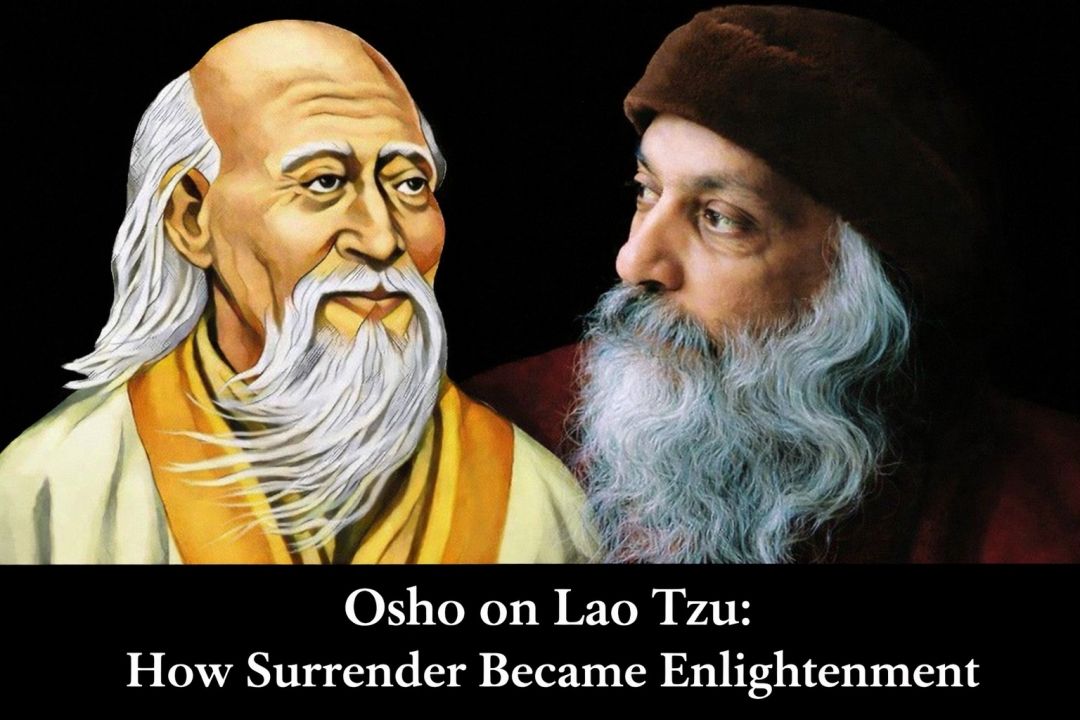
There comes a moment in every sincere seeker’s life when effort exhausts itself. The mind, after years of searching, reading, practising, questioning, and hoping, suddenly finds itself directionless. This is not the emptiness of despair alone, but the deeper emptiness where even hope has dissolved. According to Osho’s telling of Lao Tzu’s life, this was precisely the moment when truth arrived—not through striving, but through surrender.
Lao Tzu had searched relentlessly for truth. He had tried all methods available to him, followed every path known to seekers, and yet nothing revealed itself. Every effort failed. The past seemed wasted, the future meaningless. Even concepts such as liberation, God, and truth lost their significance. Nothing remained worth achieving. In that total collapse of purpose, he sat silently beneath a tree during autumn, surrounded by falling leaves, with no desire to move, no will to become anything else.
This is not defeat as we usually understand it. It is the defeat of the ego’s ambition to control existence.
The Moment of Total Stillness
When all effort disappears, something extraordinary becomes possible. Lao Tzu was no longer trying to reach the truth. He was no longer pushing toward enlightenment. He was simply sitting—utterly present, utterly empty. There was nothing to do and nowhere to go.
In that stillness, a dry leaf fell from the tree. Lao Tzu watched it without interpretation, without thought. The leaf drifted slowly, swayed by the air, rising briefly with a gust, then descending again. When the wind moved east, the leaf went east. When it moved west, the leaf followed west. The leaf had no resistance, no personal agenda, no destination of its own.
It was simply participating in the movement of existence.
And in watching this, Lao Tzu saw himself.
Learning from a Dry Leaf
Osho says that Lao Tzu attained samadhi not through scriptures or discipline, but through this silent observation of a falling leaf. In the leaf’s movement, he recognized the fundamental principle of life: harmony with the whole.
The leaf did not ask where it was going. It did not argue with the wind. It did not cling to the branch it had left behind. It trusted the process completely. Lao Tzu realized that human suffering begins the moment we impose our private desires upon the vast intelligence of existence. We want life to obey us rather than learn to flow with it.
In that instant, Lao Tzu resolved to live like the leaf—to move as existence moves him, to act only as nature acts through him. His ego dissolved into the larger rhythm of the cosmos. He would no longer have a personal plan. The universe’s plan would be enough.
Wu Wei: The Art of Non-Doing
This insight later became the foundation of Taoist philosophy, especially the principle of Wu Wei, often misunderstood as inaction. Wu Wei does not mean doing nothing. It means doing nothing against the flow of existence. It means action without resistance, effort without ego, movement without struggle.
When Lao Tzu said, “If the whole wants me to drown, then drowning itself is my shore,” he was expressing radical trust. In such trust, fear disappears. Success and failure lose their meaning. Even survival is no longer a personal obsession.
This is not passivity. It is supreme intelligence. Only when we stop interfering does life reveal its deeper order.
Why Enlightenment Comes After Giving Up
Osho repeatedly emphasized that enlightenment never comes to those who chase it. It arrives only when the seeker disappears. As long as someone is striving to become enlightened, there is tension, ambition, and division. Lao Tzu’s breakthrough happened when he abandoned the very idea of reaching somewhere.
Modern life pushes us in the opposite direction. We are taught to plan, control, optimise, and dominate. Surrender sounds like weakness. Yet Lao Tzu’s life shows that surrender is not collapse—it is alignment. When the self steps aside, existence takes over.
In that takeover, grace flows naturally.
Living as a Participant, Not a Controller
To live like Lao Tzu does not mean withdrawing from the world. It means living without friction. Relationships become softer. Decisions become intuitive. Anxiety reduces because the burden of controlling outcomes dissolves.
You still act, you still speak, you still work—but not from fear or ambition. You move like a leaf, responding to the winds of the moment. In such living, even uncertainty becomes beautiful, because you trust the intelligence that moves the stars and seasons.
And perhaps this is the deepest teaching Osho wanted to convey through Lao Tzu’s story: when you stop asking life for meaning, life starts expressing meaning through you.
References
- Lao Tzu, Tao Te Ching
- Osho, Tao: The Pathless Path
- Osho, The Book of Wisdom
Master’s in Tourism and Recreation (M.A.) at EIIET Berlin

Master’s in Tourism and Recreation program, offered by the esteemed Institute of Berlin (EIIET) in partnership with the University of Tourism and Hotel Management (WSTiH). This intensive two-year postgraduate course meticulously equips ambitious students with the advanced skills and knowledge to position themselves as financial and strategic leaders in the ever-evolving tourism industry.


No Comment