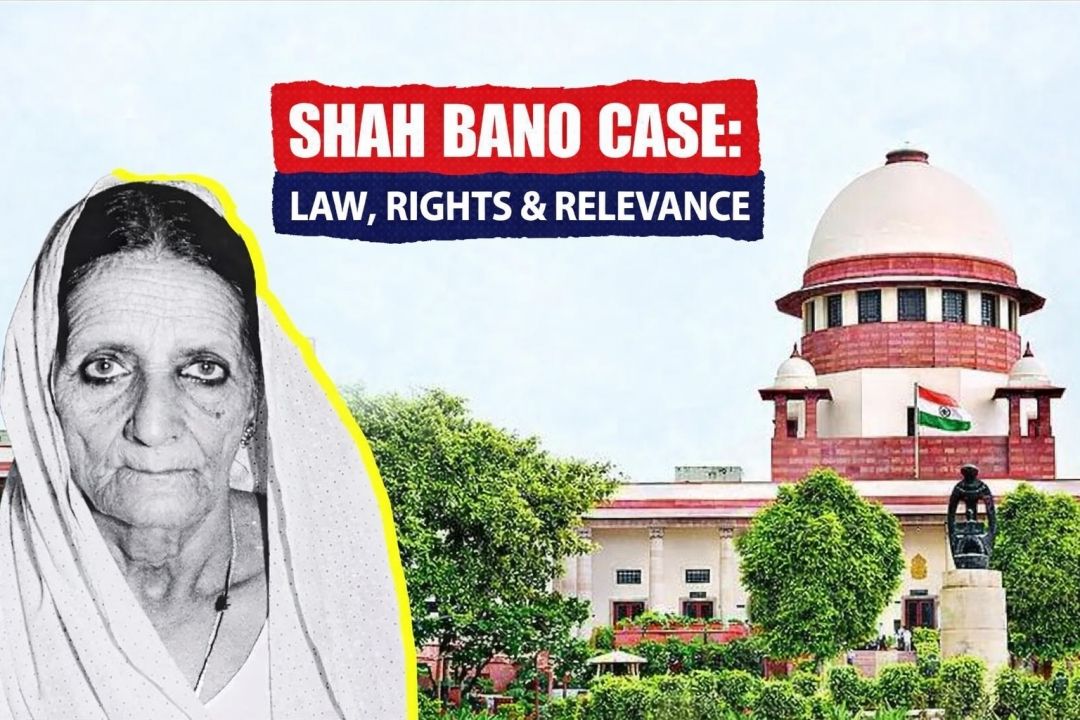
The Shah Bano Case was not merely a legal dispute over maintenance; it was a defining moment in Indian constitutional history. It reaffirmed that dignity, equality, and the right to live with security cannot be subordinated to personal law. Decades later, the case continues to shape debates on women’s rights, secularism, and the evolving relationship between law and social justice in India. To appreciate its enduring relevance in contemporary India, it is essential first to examine the case in its legal detail and then trace how its implementation reshaped subsequent legal interpretations and social realities.
Case Details: Facts, Law, and Judicial Reasoning
Shah Bano Begum was a Muslim woman from Indore who had been married for over forty years. In her old age, she was divorced by her husband, Mohammed Ahmed Khan, and left without sufficient means of subsistence. With no independent income and limited social support, she approached the magistrate’s court seeking maintenance under Section 125 of the Code of Criminal Procedure. This provision is a secular remedy, designed to prevent destitution and vagrancy by obligating those with means to support wives, children, and parents who cannot maintain themselves.
Her husband contested the claim based on Muslim Personal Law. He argued that his liability extended only up to the iddat period following divorce and that he had already fulfilled his religious obligation. The legal issue, therefore, was not merely about maintenance but about the relationship between a uniform criminal law provision and religious personal law.
The matter ultimately reached the Supreme Court of India, which delivered its landmark judgment in Mohd. Ahmed Khan v. Shah Bano Begum. The Court held that Section 125 CrPC is a secular provision applicable to all citizens, irrespective of religion. It ruled that if a divorced woman is unable to maintain herself, the husband remains legally bound to provide maintenance. The judgment emphasised that personal law cannot override a statutory provision enacted to ensure social justice and human dignity. In doing so, the Court placed constitutional values of equality and the right to live with dignity at the centre of its reasoning.
Implementation and Political Response
While the judgment was legally clear, its implementation unfolded in a far more complex manner. The ruling triggered strong opposition from conservative religious groups who perceived it as judicial interference in personal law. What followed was an intense political reaction that tested the balance between judicial independence and legislative authority.
Responding to sustained pressure, Parliament enacted the Muslim Women (Protection of Rights on Divorce) Act, 1986. The law deliberately sought to limit the practical effect of the Shah Bano judgment by confining the husband’s obligation largely to the iddat period and by shifting the responsibility for a divorced woman’s maintenance to her relatives or community institutions thereafter. From an implementation perspective, this marked a retreat from the universalist approach adopted by the Court and reflected the realities of vote-bank politics in a plural society.
At the ground level, the controversy had personal consequences for Shah Bano herself. Later accounts reveal that despite becoming a national symbol of women’s rights, she and her family faced social pressure, isolation, and hardship. The legal victory did not translate into an easy life; instead, it underscored how landmark judgments can impose a high personal cost on litigants whose cases become political symbols.
Judicial Course Correction: Danial Latifi
The 1986 Act revived constitutional tension and brought the issue back before the judiciary in Danial Latifi v. Union of India. The Supreme Court examined whether the Act violated Articles 14, 15, and 21 of the Constitution. Instead of striking down the law, the Court adopted a harmonising interpretation and held that a Muslim husband must make a reasonable and fair provision for the future of his divorced wife, a responsibility that may extend beyond the iddat period.
This interpretation effectively restored the substantive protection envisaged in Shah Bano while respecting the legislative framework. From an implementation standpoint, Danial Latifi showed how constitutional courts actively correct legislative dilution through purposive interpretation and ensure that fundamental rights retain real substance rather than being reduced to mere formalities.
Relevance to the Present Legal and Social Context
The Shah Bano case remains deeply relevant today. It continues to inform debates on the relationship between personal laws and constitutional principles, especially in discussions surrounding the Uniform Civil Code. The case also serves as a reminder that gender justice cannot be contingent on religious identity and that the right to dignity is a constitutional guarantee, not a negotiable privilege.
In contemporary India, where questions of women’s rights, religious autonomy, and state neutrality are frequently contested, Shah Bano stands as a precedent for principled adjudication. It illustrates that while courts may articulate progressive norms, their realization depends on political will, social acceptance, and sustained judicial vigilance.
Ultimately, the journey from Shah Bano to Danial Latifi shows that constitutional justice in India is often incremental rather than instantaneous. The case teaches that legal rights may face resistance in implementation, but when anchored in constitutional values, they retain the capacity to shape the law and conscience of the nation over time.
References
- Mohd. Ahmed Khan v. Shah Bano Begum, AIR 1985 SC 945 – Supreme Court of India judgment on maintenance under Section 125 CrPC and its applicability across religions.
- Code of Criminal Procedure, 1973, Section 125 – Statutory provision relating to maintenance of wives, children, and parents.
- Muslim Women (Protection of Rights on Divorce) Act, 1986 – Parliamentary enactment responding to the Shah Bano judgment.
- Danial Latifi v. Union of India, (2001) 7 SCC 740 – Supreme Court interpretation harmonising the 1986 Act with Articles 14, 15, and 21 of the Constitution.
- The Constitution of India – Articles 14 (Equality before law), 15 (Prohibition of discrimination), 21 (Right to life and personal liberty), and 44 (Uniform Civil Code).
- The Afterlife of a Landmark: How the Shah Bano Judgement Affected Her Family, Outlook India – Journalistic account examining the social and personal impact of the case on Shah Bano and her family.
William Wordsworth’s Timeless Lesson for a Noisy World

Explore William Wordsworth’s insight on wisdom, humility, and the beauty of simple living in a rushed world.


No Comment