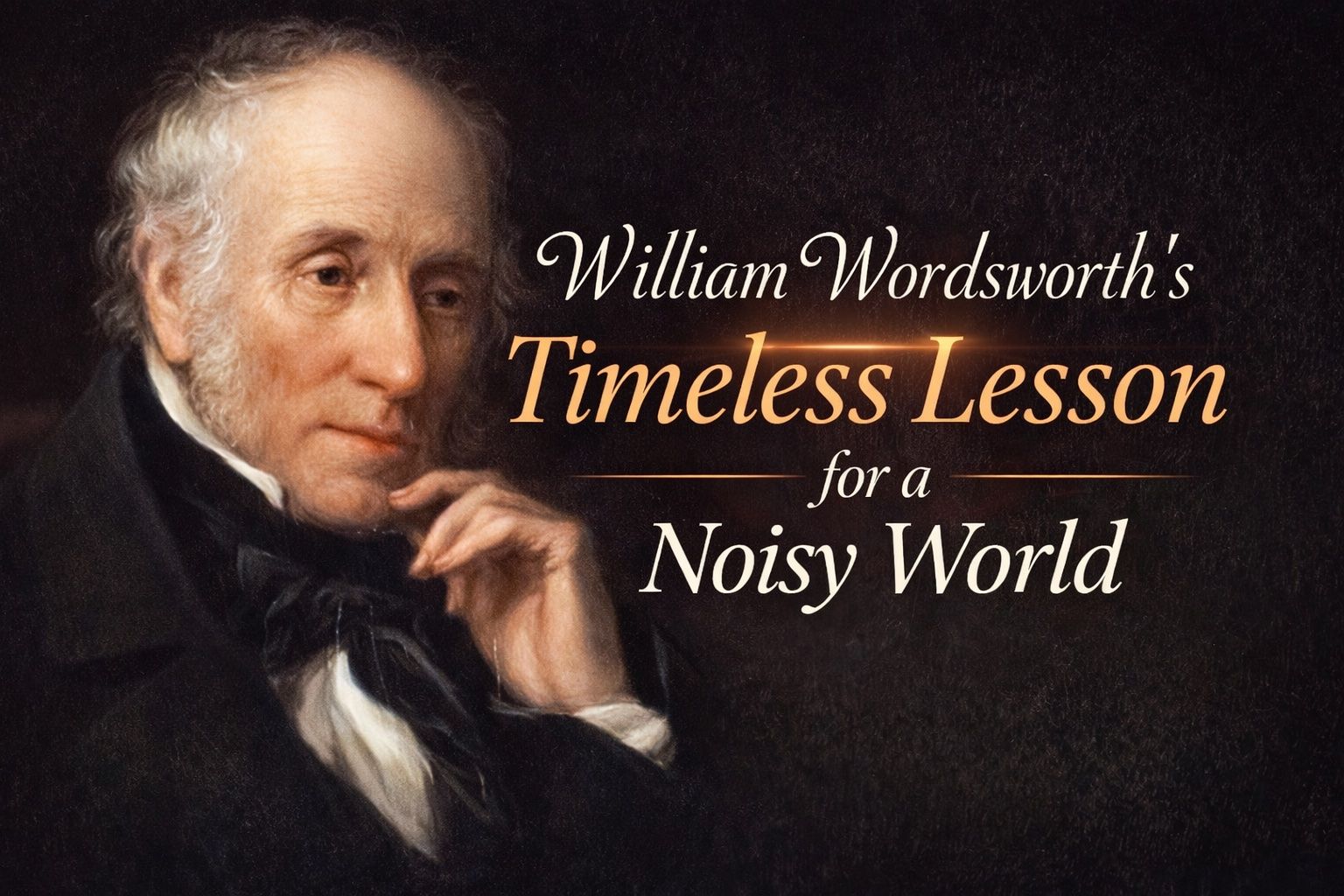
Updated on January 5th, 2026
“Wisdom is oftentimes nearer when we stoop than when we soar.” — William Wordsworth
At the start of the new year, we often think of fresh starts, ambitious plans, and bold resolutions that promise change. Yet the English Romantic poet William Wordsworth invites us to pause and look beyond the rush of achievement. His wisdom reminds us that true understanding does not always live on mountaintops or in grand success. More often, it grows quietly in everyday life, in humble moments, and in simple acts of compassion that shape us gently from within.
The Beauty of Stooping: A New Lens on Humility
Wordsworth’s profound line — “Wisdom is oftentimes nearer when we stoop than when we soar” — invites a radical reorientation of how we view success and insight. To the ambitious mind, wisdom can seem synonymous with achievement or intellectual triumph. We imagine that the highest peaks of knowledge are reached through ambition, competition, and relentless striving.
But Wordsworth suggests something different: that wisdom is closer when we stoop — when we listen, observe, and open ourselves to subtle truths. This stooping does not signify weakness. Rather, it represents humility, grounded observation, and the courage to learn from the seemingly insignificant.
This idea resonates deeply in an era that praises speed, scale, and visibility. When we stoop to gently witness a quiet moment — a child’s laughter, a friend’s unspoken pain, a flower blooming at dusk — we are not diminishing our potential. We are unveiling a more grounded and compassionate form of wisdom.
Wordsworth: Poet of the Everyday and the Eternal
Born in England’s serene Lake District in the late 18th century, Wordsworth was one of the founders of English Romanticism — a movement that celebrated emotion, nature, memory, and the individual spirit. Growing up amid loss and landscape, he learned early that depth often hides within simplicity. His poetry stands as a testimony to finding the extraordinary in the ordinary. Unlike many poets of his time, Wordsworth did not chase grandeur or rely on exotic themes and classical allusions. He believed that poetry should reflect everyday life, be expressed in simple language, and stem from reflection, emotion, and genuine lived experience. This was revolutionary when Lyrical Ballads — the defining anthology of Romantic poetry — was published in 1798 with Samuel Taylor Coleridge.
Wordsworth’s life was not marked by relentless glamour. Instead, it was shaped by thoughtful wandering through nature, deep friendship with his sister Dorothy, and an unwavering curiosity about the human heart. Through it all, he saw wisdom not as something to conquer, but something to receive. And that’s where stooping becomes an act of courage.
Seeing the Deep in the Small
Let us explore what it means to stoop.
To stoop is to show up. It is to observe without judgment. It is to embrace silence. Myriad Wordsworth quotations extol moments of quiet reflection that reveal truth and resilience — like, “The best portion of a good man’s life is his little, nameless, unremembered acts of kindness and love.”
Every act of unnoticed kindness — holding a door, offering a sincere smile, listening to someone who feels unseen — whispers wisdom in our hearts. Wordsworth understood that these seemingly insignificant gestures are the very threads that weave the fabric of human dignity and deep connection.
He also wrote, “Come forth into the light of things, let nature be your teacher.” In nature, there is no hurry. Leaves fall in their own time. Rivers follow the path of least resistance. Even in dormant winter days, there is a steady, patient rhythm of life at work. To bow in nature’s presence is to recognise that patience and mindfulness are timeless virtues — they provide glimpses into deeper, wiser living.
This poetic wisdom asks us to slow down, to breathe, to observe the sturdy oak as it braves the wind, the river as it sings under moonlight, and the unassuming daisy that continues to bloom — small but resolute.
Stooping in Daily Life: Practice Over Pride
To stoop isn’t weakness. It’s to make space for meaning that is felt rather than flaunted. In a world that applauds loud victories and dazzling accomplishments, Wordsworth’s message is a gentle knock on the door of the soul: In sikh philosophy, we call it ‘Sehaj’
Look inside. Look closely.
Here’s a practice inspired by his words: today, observe without haste. Seek beauty in simplicity. When frustration rises, pause. Choose empathy. When pride urges you to ascend, remember that wisdom may be translating a lesson right beneath your feet. Whether it’s forgiving someone who hurt you or acknowledging a personal flaw, these are acts of stooping that bring depth and purpose to life.
Stooping and Soaring: A Harmonious Balance
This is not an argument against ambition. To soar — to reach, explore, and grow — is a vital part of human aspiration. Yet Wordsworth teaches that true wisdom is not only found in soaring high, but also in the humility to stoop and reflect.
In practical terms, career success, artistic genius, and scholarly mastery can be complemented by kindness, patience, and sensitivity. The most compelling leaders are those who listen. The most respected innovators are those who learn from every failure. Stooping and soaring need not be opposites; they can be harmonious expressions of a life well lived. And this act makes you more grounded in nature. I personally practised it many times in moments that are close to my heart.
Carrying Wordsworth Forward
As the calendar turns and we embark on new journeys, Wordsworth’s wisdom is a timely reminder that success and insight are not always measured in grand metrics. True understanding often begins in quiet moments — a simple conversation, a reflective walk, a humble act.
Today, let us embrace both ambitions that lift us and the humble practices that deepen us. In doing so, we honor not just the height of our aspirations, but also the depth of our humanity.
So as you go about your day, remember:
Wisdom might just be waiting where you least expect it — in the quiet, humble spaces where you choose to stoop.
References
- Wordsworth, William. Selected Poems and Prefaces. Various editions, including Lyrical Ballads (1798), co-authored with Samuel Taylor Coleridge
- Economic Times. Quote of the Day: William Wordsworth – “Wisdom is oftentimes nearer when we stoop than when we soar.”
- Abrams, M. H. The Norton Anthology of English Literature. W. W. Norton & Company – sections on Romantic Poetry and Wordsworth.
- Gill, Stephen. William Wordsworth: A Life. Oxford University Press.
Master’s in Tourism and Recreation (M.A.) at EIIET Berlin

Master’s in Tourism and Recreation program, offered by the esteemed Institute of Berlin (EIIET) in partnership with the University of Tourism and Hotel Management (WSTiH). This intensive two-year postgraduate course meticulously equips ambitious students with the advanced skills and knowledge to position themselves as financial and strategic leaders in the ever-evolving tourism industry.


No Comment