Updated on June 10th, 2026
There is a quiet turning point in every thoughtful life—a moment when the outer world, with all its achievements, ambitions, and attachments, no longer feels sufficient. Beneath the surface of daily existence, a deeper inquiry begins to stir: What is the essence of my being? What is truly real? It is in response to this timeless human quest that the Upanishads arise—serene, profound, and luminous—offering not answers to be accepted, but truths to be discovered within.
Emerging from the spiritual heritage of the Vedas, the Upanishads are revered as Vedanta, the culmination and highest flowering of Vedic wisdom. Yet their greatness lies not merely in their antiquity, but in their approach. They gently move us away from the outer layers of ritual and form, guiding us instead toward inner awakening and direct experience. In their pages, philosophy is not an abstract exercise—it becomes a living exploration of consciousness, existence, and ultimate reality.
The Upanishads do not command belief, nor do they offer ready-made conclusions. They speak in a voice that is at once subtle and powerful, urging the seeker to question, to reflect, and to realise. In doing so, they transform the search for meaning into a journey inward—where knowledge is not acquired, but uncovered, and where truth is not taught, but experienced.
Sitting Near the Truth
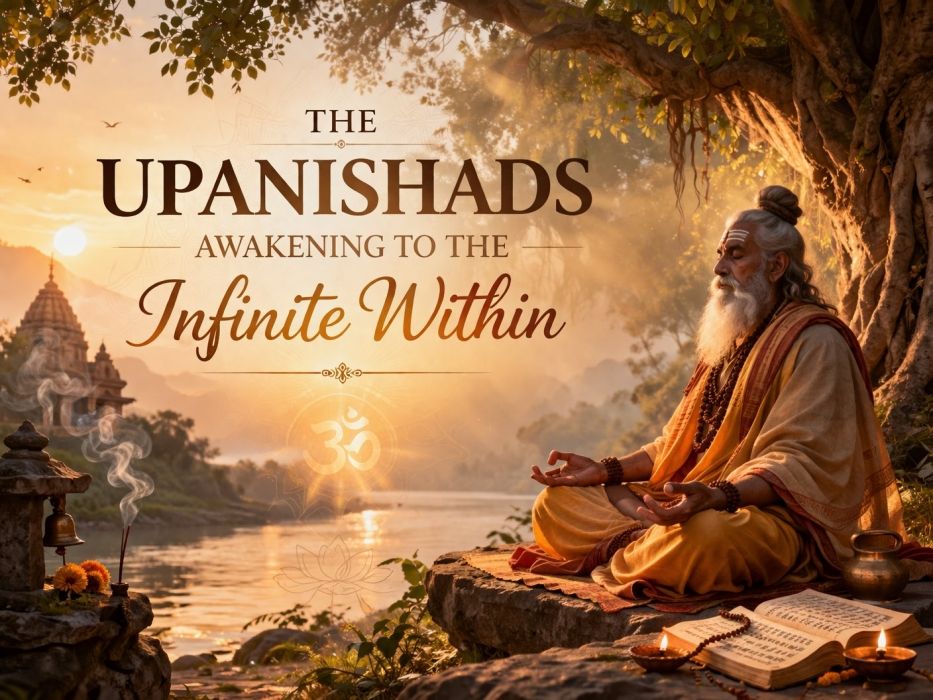
The very word “Upanishad” carries a profound image. The Sanskrit roots—Upa (near), Ni (down), and Shad (to sit)—portray a sacred scene in which a student sits at the feet of a teacher and absorbs wisdom that books alone cannot impart. Knowledge was not intellectual information; it was transformation.
For centuries, this wisdom was passed down orally, from heart to heart. The teacher did not merely instruct; he transmitted a way of seeing the world.
The Eternal Dialogue: Brahman and Atman
At the core of the Upanishads lies a question that is both simple and profound: What is the nature of reality? The answer unfolds through two key ideas—Brahman and Atman. Brahman is the ultimate reality, the infinite, all-pervasive consciousness that exists beyond time and space. It is not something distant or abstract; it is the very essence of everything that exists.
Atman, on the other hand, is the inner self—the silent witness within us that remains unchanged even as our body, thoughts, and emotions constantly shift. The Upanishads reveal a startling truth: Atman and Brahman are not separate. The individual self is not different from the universal reality.
This realisation is often explained through simple yet powerful analogies. Just as all ornaments made of gold are ultimately nothing but gold, or all clay pots are nothing but clay in different forms, everything in the universe is an expression of the same underlying reality. We are not separate fragments—we are expressions of the infinite.
The Illusion of Separation
If this unity is true, then why do we feel separate, limited, and often fearful? The Upanishads answer this through the concept of Maya—the illusion that makes the one appear as many. It is like mistaking a rope for a snake in the darkness. The fear feels real, but the cause is an illusion. The moment light is brought in, the illusion disappears.
In the same way, ignorance of our true nature creates a sense of separation. This illusion binds us to the cycle of karma and rebirth, where every action leaves an imprint and shapes our future experiences. We begin to identify ourselves with temporary roles, forgetting our eternal essence.
Moksha: The Freedom Within
The goal of the Upanishads is not to take us somewhere else but to awaken us to what we already are. This awakening is called Moksha, or liberation. Moksha is not a destination after death; it is a state of understanding. It is the realisation that we are not limited beings struggling in a vast universe, but the very consciousness in which the universe appears. It is the discovery that we are already whole, already complete.
This realisation dissolves fear, as fear can exist only where there is a sense of separation. When we recognise our unity with existence, life becomes a flow rather than a struggle.
Stories that Illuminate Truth
The Upanishads do not teach through dry philosophy alone; they bring ideas to life through powerful stories. In the Katha Upanishad, the young seeker Nachiketa stands before Yama, the god of death, asking the ultimate question: What happens after death? Offered wealth, power, and pleasures, he refuses them all, choosing the path of truth instead. His choice between Shreya (the good) and Preya (the pleasant) reflects the eternal human dilemma.
In another beautiful story from the Chandogya Upanishad, a father teaches his son Shvetaketu by dissolving salt in water. The salt disappears, yet its presence is felt in every drop. In the same way, the divine essence is invisible yet present everywhere. The lesson culminates in the profound statement: Tat Tvam Asi—”Thou Art That.”
The Mahavakyas: Seeds of Realisation
The Upanishads distil their wisdom into four great declarations, known as the Mahavakyas, and present them as powerful insights for deep contemplation rather than mere philosophical statements.
They guide the seeker from intellectual understanding to direct realisation. Each statement gently dismantles the illusion of separateness and points toward the infinite nature of the self.
Ancient Wisdom for a Modern Mind
In today’s fast-paced, digitally connected world, the teachings of the Upanishads feel more relevant than ever. We are constantly connected to screens, yet increasingly disconnected from ourselves. The Upanishads remind us to turn inward. They encourage us to observe the “witness” within—the silent awareness behind our thoughts. Interestingly, modern psychology and neuroscience are beginning to validate this approach. Practices like mindfulness and meditation, rooted in these ancient insights, are now proven to reduce stress and enhance well-being.
The Mandukya Upanishad even explores different states of consciousness—waking, dreaming, deep sleep, and a fourth state called Turiya, which represents pure awareness. It is a concept that resonates deeply with contemporary explorations of consciousness.
The Journey Back to the Self
Ultimately, the Upanishads are not about acquiring new knowledge but about removing ignorance. They do not ask us to become something new; they remind us of what we have always been. In a world driven by achievement and accumulation, their message is both radical and comforting: true happiness does not lie in having more, but in being more aware. The peace we seek is not outside—it is the very nature of our being.
The Upanishads whisper a timeless truth into the ears of every seeker: You are not incomplete. You are not separate. You are the infinite itself, temporarily forgetting its own vastness.
And perhaps, the real journey of life is simply this—to remember.
References:
- Radhakrishnan, S. – The Principal Upanishads
- Eknath Easwaran – The Upanishads
- Swami Vivekananda – Complete Works
- Brihadaranyaka Upanishad
- Harvard Centre for the Study of World Religions (online resources)
Chasing Clouds: A Beautiful Journey from Sacred Ganga to Mountains

Chasing Clouds: A beautiful journey from Haridwar to Mussoorie and Landour, exploring monsoon mountains, misty roads, nature, love and unforgettable moments.


No Comment