Updated on August 31st, 2026
The history of Punjab’s princely states is filled with magnificent palaces, powerful rulers, and unforgettable personalities. Yet few stories are as intriguing—or as controversial—as that of Princess Gobind Kaur of Kapurthala, a royal woman remembered in local folklore as the “Desi Cleopatra.”
Celebrated for her remarkable beauty, fearless personality, and unconventional lifestyle, Princess Gobind Kaur became one of the most talked-about figures of her time. Over the decades, stories about secret tunnels, forbidden romances, daring escapes, and an extraordinary fall from royal luxury to rural simplicity have transformed her into a legendary figure. While many of these accounts survive through oral tradition rather than official records, they continue to fascinate historians, storytellers, and visitors to Kapurthala alike.
A Princess Who Refused to Follow Tradition
Princess Gobind Kaur’s story began with a bold act of defiance. When tradition demanded that royal brides leave their parental homes and settle with their husbands, she refused to follow convention. Instead, she chose to stay in Kapurthala—the city she loved—even though her husband’s residence lay only a few miles away.
Instead of challenging her decision, her father, Maharaja Nihal Singh, reportedly commissioned the construction of a magnificent six-storey residence for the royal couple near the palace complex.
The towering palace soon became one of Kapurthala’s most distinctive landmarks. From its balconies, Princess Gobind Kaur often watched the bustling streets below, standing as a regal figure overlooking the very city she had firmly refused to leave.
The Woman Behind the Title “Desi Cleopatra”
Princess Gobind Kaur earned the nickname “Desi Cleopatra” not simply because of her celebrated beauty, but because of her bold personality and refusal to conform to royal expectations. While many princesses of her era followed royal expectations, Princess Gobind Kaur forged her own path. She valued her independence, spoke with confidence, and lived life according to her own rules.
As time passed, her relationship with her husband reportedly deteriorated, and they gradually began living separate lives. While the prince spent much of his time elsewhere, Princess Gobind Kaur remained in her grand palace, surrounded by luxury and attended by loyal servants.
It was during this period that stories of her romantic adventures began to spread across the princely state, eventually becoming an enduring part of Kapurthala’s folklore.
The Prime Minister and the Legendary Tunnel of Love
Among the most famous legends is her alleged romance with Nawab Ghulam Gilani, the Prime Minister of Kapurthala State.
The Nawab was admired for his dignified appearance, refined manners, and distinguished personality. According to local tradition, he first became enchanted by the princess after seeing her on the palace rooftop, where she was drying her long hair in the afternoon sun. Their affection reportedly developed into a secret relationship that required extraordinary measures to remain hidden from the royal court.
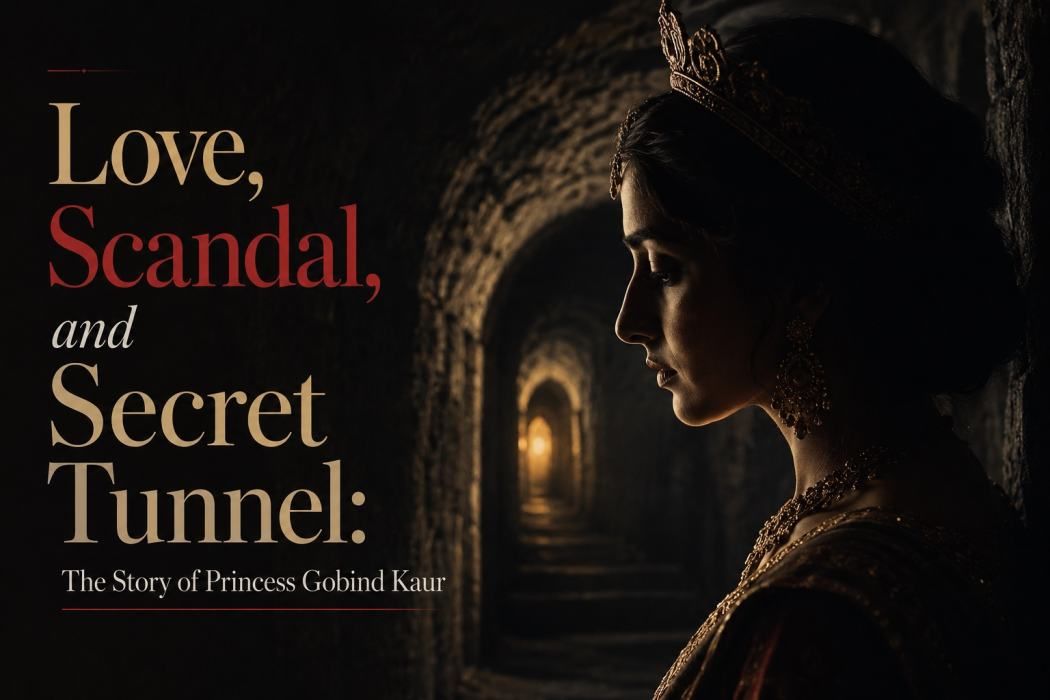
Legend claims that an underground passage stretching nearly a mile was constructed between the Nawab’s residence and the princess’s palace. Hidden beneath the streets of Kapurthala, the tunnel supposedly allowed the two to meet away from the watchful eyes of palace officials and political rivals.
Although historians continue to debate whether such a tunnel ever truly existed, the story remains one of Kapurthala’s most enduring legends.
Disguises, Secret Meetings, and Royal Intrigue
When the underground passage could not be used, folklore suggests that Princess Gobind Kaur adopted even more daring methods. One popular story describes her disguising herself as a palace maid before hiding inside a large storage trunk carried on the Nawab’s horse-drawn carriage. Only after the carriage had safely left the city would she emerge, allowing the couple to spend time together far from curious onlookers.
Whether fact or folklore, these stories contributed greatly to her reputation as one of the most unconventional royal women in Punjab’s history.
Colonel Varyam Singh and the Hidden Well
Another chapter of local legend introduces Colonel Varyam Singh, a respected military officer serving the Kapurthala State. According to oral accounts, the Colonel and the princess developed a close relationship after her alleged romance with the Nawab.
This time, their secret meetings supposedly relied upon a concealed entrance hidden beside an old well near the palace wall.
Every night, a trusted maid would lower a rope into the well, allowing the Colonel to climb silently into the palace. Inside the palace, Princess Gobind Kaur reportedly welcomed him into richly decorated chambers adorned with fragrant jasmine flowers, rose petals, and exquisitely embroidered Banarasi silks.
Before sunrise, he would return through the same hidden route, carefully concealing every trace of his visit.
Discovery, Escape, and Another Secret Tunnel
Eventually, the rumours surrounding the princess reportedly reached the ears of Sardar Danishmand, the Home Minister of Kapurthala State. Determined to uncover the truth, he allegedly arrived at the palace accompanied by the Inspector General and a contingent of soldiers.
As officials forced their way toward the princess’s private apartments, Princess Gobind Kaur and Colonel Varyam Singh are said to have escaped through yet another underground passage. The tunnel reportedly ended at a distant well nearly one hundred yards from the palace.
Local legend claims the pair spent an entire night hiding in the well’s cold water while search parties combed the surrounding area. By dawn, they had escaped the palace—and, according to the story, left their royal lives behind forever.
From Palace Grandeur to Village Simplicity
Perhaps the most remarkable part of Princess Gobind Kaur’s legend is not her romances or secret passages, but the dramatic transformation of her later life. By challenging convention and choosing personal freedom over royal protocol, Princess Gobind Kaur carved out a legacy that inspired countless stories in which history and folklore intertwine.
The Colonel, once an esteemed military officer, worked as an ordinary farmer.
Princess Gobind Kaur, who had once worn priceless jewels and lived in one of Punjab’s grandest palaces, adapted to rural life with remarkable resilience. Local stories describe her helping with household chores, preparing fuel from cow dung, and sharing the everyday responsibilities of village life.
Whether every detail is historically accurate or embellished through generations of storytelling, the image remains powerful—a princess exchanging royal splendour for a life of simplicity.
The Legacy of Kapurthala’s Most Mysterious Princess
Princess Gobind Kaur continues to occupy a unique place in Kapurthala’s cultural memory.
Princess Gobind Kaur turned her back on royal privilege and reportedly began a new chapter with Colonel Varyam Singh. Together, they settled in a quiet village, built a modest home, and embraced a life far removed from the grandeur of the palace.
The secret tunnels, hidden wells, daring disguises, and dramatic escapes have never been fully verified through historical evidence, yet they remain an inseparable part of Kapurthala’s rich oral tradition.
Today, visitors exploring the city’s magnificent palaces often hear whispers of the “Desi Cleopatra”—a princess whose extraordinary life has become one of Punjab’s most captivating legends.
Whether viewed as history, folklore, or a blend of both, the story of Princess Gobind Kaur continues to remind us that some of the most fascinating royal tales are those that leave just enough mystery to endure across generations.
William Wordsworth’s Timeless Lesson for a Noisy World

Explore William Wordsworth’s insight on wisdom, humility, and the beauty of simple living in a rushed world.


No Comment