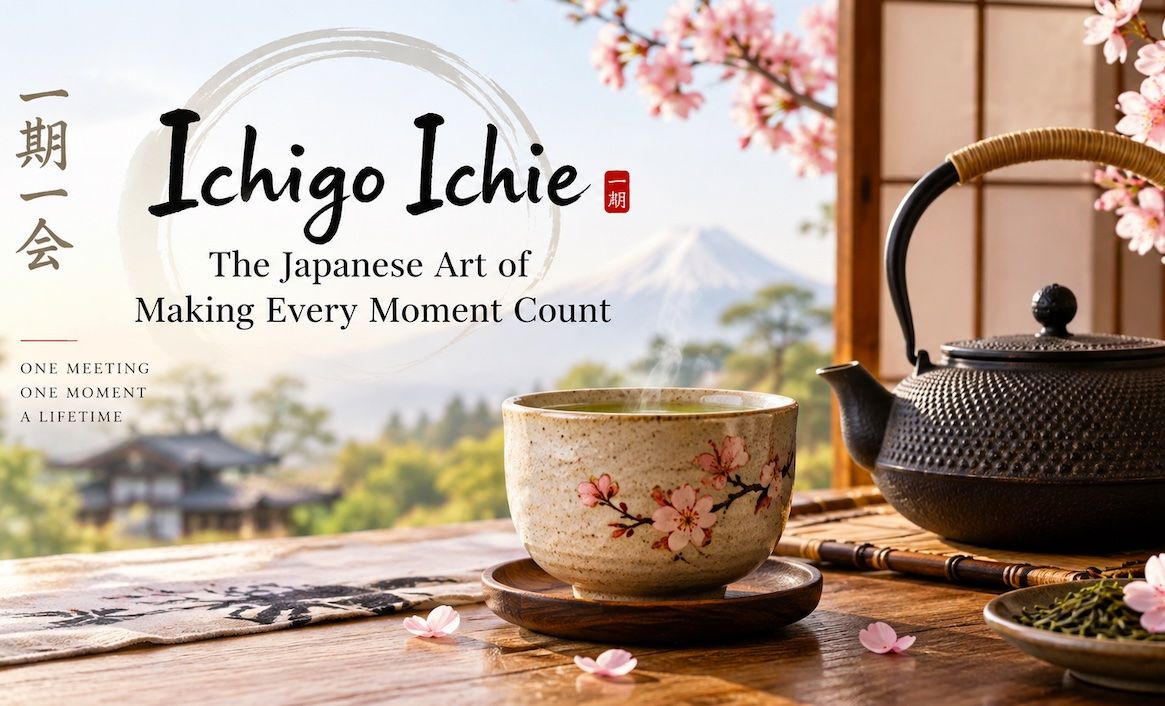
There is a quiet wisdom in the Japanese way of looking at life: some moments happen only once. We may return to the same place, meet the same person again, or sit at the same table, but the particular combination of people, emotions, circumstances, and time can never be reproduced. This idea is captured beautifully in the Japanese expression Ichigo Ichie, often understood as “one time, one meeting” or “one chance in a lifetime.”
Ichigo Ichie is not simply an invitation to enjoy the present. It is a way of seeing life with greater attention. It asks us to recognize that ordinary moments—sharing tea, talking with a friend, watching rain, traveling, or sitting quietly with someone we love—may be far more precious than we realize.
Héctor García and Francesc Miralles explored this philosophy in The Book of Ichigo Ichie, describing it as a practice of making each moment unique and appreciating it before it disappears.
The Meaning Behind Ichigo Ichie
The expression has its roots in Japanese tea culture. In a traditional tea gathering, guests and the host are encouraged to treat their meeting as something unrepeatable. Even if the same people gather again tomorrow, tomorrow’s meeting will not be today’s meeting.
This simple observation carries a profound message: do not take the present for granted.
We often live as though life will always provide another opportunity. We postpone conversations, delay journeys, neglect friendships, and imagine that there will always be another day. Ichigo Ichie gently challenges that assumption.
It does not mean that we should live recklessly or desperately pursue pleasure. Rather, it encourages us to pay attention to what is already happening.
The Tea Room and the Art of Presence

The philosophy becomes especially meaningful when viewed alongside Japanese tea culture.
Kakuzō Okakura’s classic The Book of Tea, first published in 1906, presents the Japanese tea ceremony as something much larger than the preparation and drinking of tea. Okakura connects tea with simplicity, harmony, aesthetics, humility, and a deeper appreciation of everyday life.
The tea room creates a small world in which attention matters. The arrangement of the room, the bowl, the flowers, the host’s movements, and the guests’ presence all become part of the experience.
Nothing needs to be spectacular.
A cup of tea can become meaningful simply because everyone present is truly there.
That is one of the most beautiful lessons of Ichigo Ichie: the value of a moment does not depend on how extraordinary the event appears from the outside. It depends on how fully we experience it.
Why We Miss the Present
Modern life makes this philosophy surprisingly difficult to practice.
Our minds constantly move between yesterday and tomorrow. We remember what went wrong, worry about what might happen, plan the next task, and check what is happening elsewhere. Even when we are physically with someone, our attention may be somewhere else.
We may sit with our family while looking at our phones. We may travel to a beautiful place while thinking about work. We may meet an old friend while worrying about the next appointment.
The moment arrives—and we are already preparing to leave it.
Ichigo Ichie asks us to reverse this habit.
Be where you are. See what is in front of you. Listen to the person speaking to you. Let the moment be enough.
Ichigo Ichie and Zen
There is a natural connection between Ichigo Ichie and Zen ideas of mindfulness and impermanence. Shunryu Suzuki’s Zen Mind, Beginner’s Mind, another influential work on Japanese Zen, emphasizes approaching experience with openness and without excessive preconceptions. The book has become a modern classic of Zen writing, particularly for its emphasis on simplicity, presence, and maintaining a curious mind.
Ichigo Ichie shares this spirit. If we believe we already know what a person, place, or experience will be like, we stop seeing it freshly. We begin to live through assumptions.
The beginner, however, looks again. A familiar road can suddenly appear beautiful. A conversation with a parent can reveal something previously unnoticed. A rainy afternoon can become memorable simply because we stopped rushing through it.
Perhaps this is why the philosophy feels less like a rule and more like an invitation.
Every Meeting Changes Us
One of the deepest ideas behind Ichigo Ichie is that people we meet are never exactly the same twice. We ourselves change. Other people change. Circumstances change.
A conversation that seems ordinary today may become precious years later. A dinner with friends may eventually become a memory of a particular period of life. A journey may be remembered not for the destination but for the people who traveled with us.
This gives relationships a different kind of importance. Instead of asking, “What do I get from this meeting?”, Ichigo Ichie encourages another question:
“How completely can I be present for this meeting?”
That small change in perspective can make relationships warmer and more meaningful.
The Connection with Ikigai
Readers familiar with García and Miralles’s earlier work, Ikigai: The Japanese Secret to a Long and Happy Life, may notice a similar concern with living meaningfully. Ikigai explores purpose, fulfillment, and the reasons that make life worth living, while The Book of Ichigo Ichie turns attention toward the preciousness of individual moments. The two ideas complement each other: one asks what gives life meaning; the other asks whether we are sufficiently present to experience that life.
Together, they suggest that a meaningful life is not created only through grand achievements. It is also created through small moments lived attentively.
We Have Less Time Than We Imagine
Oliver Burkeman’s Four Thousand Weeks: Time Management for Mortals approaches the question from another direction. Burkeman points out that an eighty-year life contains only a little over four thousand weeks and argues against our obsession with trying to accomplish everything. His central concern is how we choose to spend our limited time.
This idea sits comfortably beside Ichigo Ichie. We cannot attend every event, visit every place, read every book, or maintain every possible relationship. Time will always be limited.
Once we accept that limitation, the present becomes more valuable. The goal is not to squeeze more experiences into life. It is to experience the experiences we choose more deeply.
Practicing Ichigo Ichie in Everyday Life
Ichigo Ichie does not require a tea room, a meditation retreat, or a journey to Japan. It can begin with ordinary life.
- When having tea with someone, put the phone away.
- When eating, taste the food instead of rushing through it.
- When speaking to a loved one, listen without preparing your reply.
- When traveling, stop occasionally and simply observe.
- When watching the sunset, resist the urge to photograph everything immediately.
- When meeting an old friend, remember that neither of you is exactly the person you were the last time you met.
And sometimes, do nothing at all. Simply notice the moment.
The Courage to Let a Moment End
There is also something beautiful—and slightly sad—about Ichigo Ichie. Its message depends on impermanence.
The moment is precious precisely because it will disappear.
The conversation ends. The tea becomes cold. The journey comes to an end. Friends eventually return home. A particular evening becomes a memory.
We cannot hold these things permanently. But perhaps we do not need to. The purpose of a beautiful moment is not to make it last forever. It is to receive it fully while it is here.
A Philosophy for a Distracted Age
In an age of constant notifications, endless scrolling, and perpetual busyness, Ichigo Ichie offers an almost radical simplicity.
It tells us to stop trying to live everywhere at once.
Be here. Be attentive. Be grateful. Look carefully at the people around you. There may never be another moment exactly like this one. That is not a reason for sadness. It is a reason for appreciation.
This Moment Will Never Come Again
Ichigo Ichie ultimately transforms the ordinary into something worthy of attention. It teaches us that life is not only the collection of major milestones we remember—birthdays, weddings, promotions, journeys, and celebrations. Much of life happens quietly between those milestones.
- A cup of tea.
- A shared laugh.
- A long conversation.
- Rain against a window.
- A walk at dusk.
- A familiar face across the table.
These moments may seem insignificant as they happen. Later, they can become the memories we treasure most. Perhaps the wisdom of Ichigo Ichie can therefore be expressed in one simple thought:
Meet this moment as though it has come only once—because, in truth, it has.
You Can’t Go in the Same River Twice: Travel Experiences

A reflective travel blog on Dalhousie, Khajjiar, McLeod Ganj, Dharamkot, Kasol and Tosh, exploring change, travel and life’s deeper meaning.


No Comment