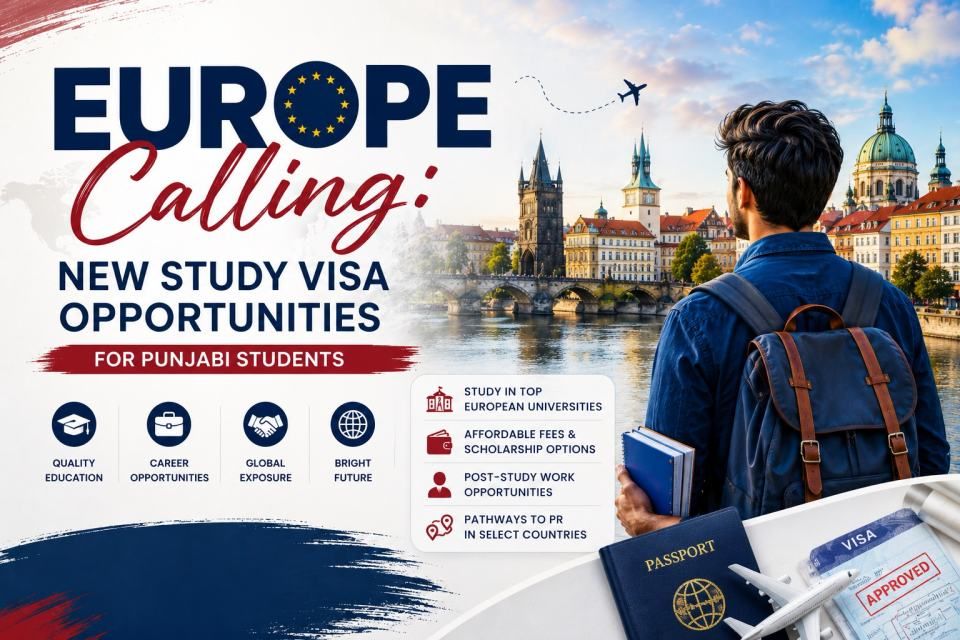
For generations, going abroad has been more than a career decision for Punjabi families—it has been a dream, an aspiration, and, often, a carefully planned investment in the future. From village homes to the cities of Jalandhar, Ludhiana, Amritsar, and Patiala, thousands of young people have looked beyond India’s borders for better education, international exposure, and stronger career opportunities.
But the overseas education landscape is changing.
The traditional Canada-focused approach that once dominated Punjab’s study-abroad market has faced significant challenges. According to the reports, Canada-related inquiries have fallen sharply, while stricter policies, increased scrutiny, and changing immigration conditions have affected the wider student visa industry. At the same time, the desire among Punjabi students to study overseas has not disappeared. Instead, the destination is changing.
For students who have completed Class 12 or graduation, this changing environment creates an important opportunity: to look beyond familiar destinations and explore carefully selected study pathways, particularly across Europe.
Punjab’s Overseas Education Dream Is Still Strong
Despite recent turbulence, Punjab remains one of India’s strongest study-abroad markets and is among the leading states driving demand for overseas education. The report notes that students continue to show strong interest in Europe, Australia, and other alternative destinations even as demand for Canada has weakened.
This tells us something important: Punjabi students are not giving up on international education—they are becoming more selective.
Students and parents increasingly want to know what they are investing in. They are asking questions about course relevance, total cost, employment opportunities, post-study options, and long-term return on investment. For a Class 12-pass student, this means choosing the right program before choosing the country. For a graduate, it means finding a course that adds genuine value to an existing qualification rather than simply selecting a program because admission appears easy.
Options for Class 12-Pass Students
For students who have completed their 12th standard, overseas education can open the door to undergraduate studies, diplomas, and other career-oriented programs, depending on the destination and institution.
The most important decision at this stage is career direction.
A student interested in business should not simply choose any business course. A student interested in technology should consider whether the program develops skills relevant to the modern employment market. Similarly, students interested in hospitality, tourism, healthcare, logistics, or other sectors should examine whether their chosen program provides meaningful academic and practical value. Students are looking for career-oriented and ROI-driven programs.
This is particularly important for 12th-pass students, as their first international qualification can influence their future studies, employment, and professional direction.
Study Visa Options for Graduate Students
Graduates have a different advantage. They already have an academic foundation and can use overseas education to specialize, upgrade their skills, or move into a new career field.
For a graduate considering Europe, the focus should be on identifying a program that connects logically with previous education, professional interests, and future career plans. Media reports recommend creating clear country- and outcome-specific pathways that take into account factors such as entry requirements, language expectations, typical costs, and realistic employment prospects after graduation.
This approach is particularly valuable for graduates because a carefully selected postgraduate program can become more than an academic qualification—it can be a strategic career investment.
Why Europe Deserves Serious Consideration
Europe is emerging as an increasingly important alternative for Punjabi students seeking to diversify their study-abroad options. Students are asking for Germany, Finland, Denmark, Malta, Latvia, and other Schengen destinations where they can find better study and career opportunities.

For students, the attraction is not simply the opportunity to live abroad. The bigger question is whether the destination offers a sensible combination of education, affordability, employability, and future opportunities. Europe also gives students the option to consider different countries and academic systems rather than placing all their expectations on a single destination.
That diversification matters in today’s environment. There are different programs for different career paths in different destinations. A right consultant will guide you in your progression in studies, leading to a better career.
Therefore, the right question is no longer simply: “Which country will give me a visa?”
The better question is: “Which course and destination can help me build a better career?”
That change in mindset can make a significant difference to the quality of an overseas education decision.
Choosing the Right Path After 12th or Graduation
The future of overseas education in Punjab is not about abandoning the dream of going abroad. It is about becoming smarter about that dream. A Class 12-pass student should focus on course relevance, career direction, and affordability. A graduate should focus on specialization, employability, and long-term professional value.
If you are planning your further studies, drop a WhatsApp text on +91-9888481965
Both should look beyond attractive promises and examine the complete pathway—from admission and visa preparation to education, employment, and future opportunities.
I feel demand is shifting rather than disappearing. That may ultimately be a positive development. Students who once focused almost exclusively on one destination are now exploring a wider range of possibilities.


The Road Ahead for Punjabi Students
The international education market may be changing, but the ambitions of Punjabi students remain remarkably strong. As a consultant, I feel the new generation must focus on their careers rather than on visas. It needs a well-planned educational and career pathway.
Whether you are a student who has just completed Class 12 or a graduate looking for international specialization, Europe and other emerging destinations deserve careful consideration. The right decision should be based on your academic profile, financial circumstances, career ambitions, and realistic future prospects.
In the new study-abroad era, success will not belong simply to those who travel the farthest. It will belong to those who choose wisely, prepare honestly, and build their international education around a clear career goal.
Master’s in Tourism and Recreation (M.A.) at EIIET Berlin

Master’s in Tourism and Recreation program, offered by the esteemed Institute of Berlin (EIIET) in partnership with the University of Tourism and Hotel Management (WSTiH). This intensive two-year postgraduate course meticulously equips ambitious students with the advanced skills and knowledge to position themselves as financial and strategic leaders in the ever-evolving tourism industry.


No Comment