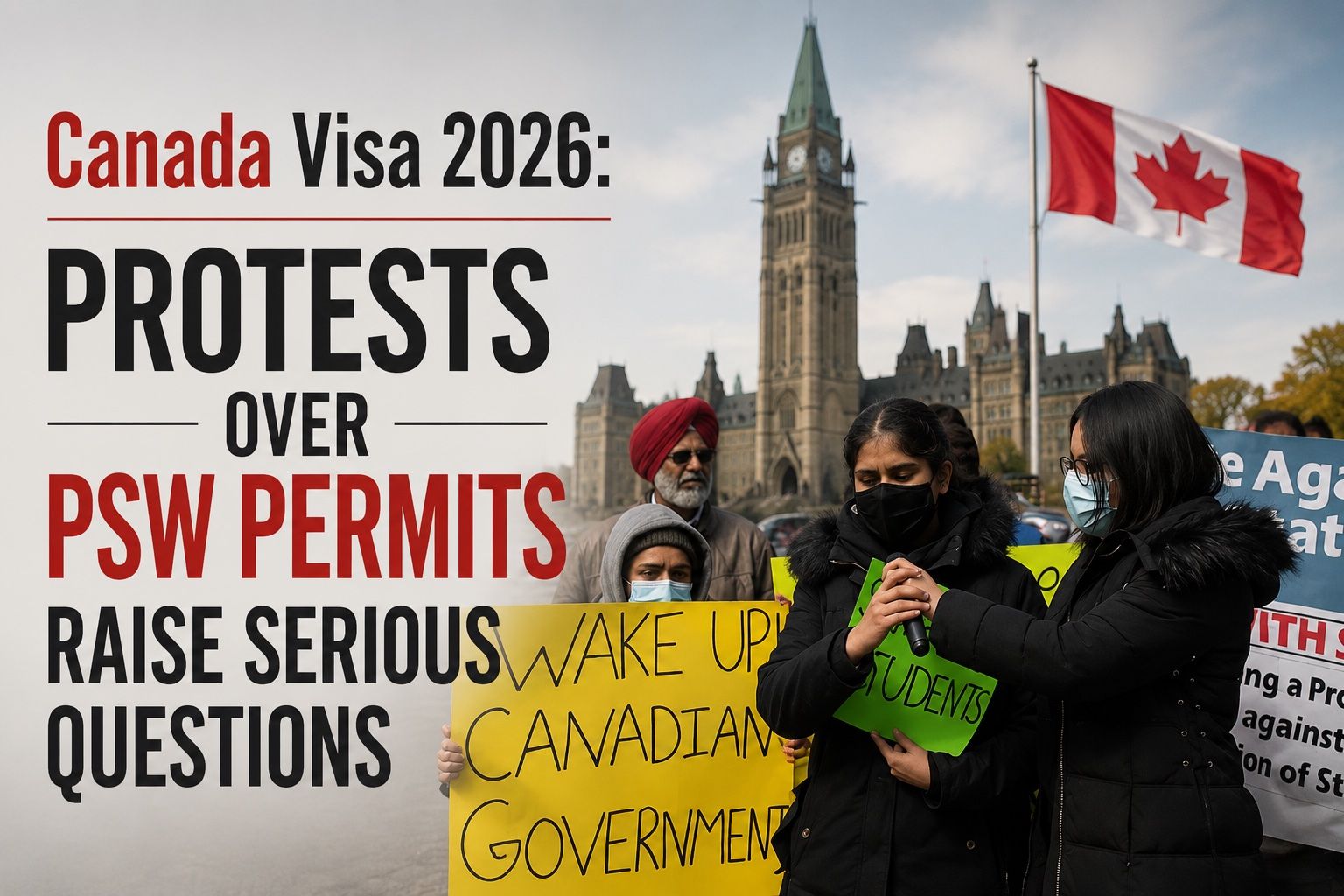
Protests in Canada Send a Warning to Future Students
The streets of Calgary and Edmonton have recently become the center of growing protests by international students and graduates demanding answers about Post-Graduation Work Permits (PGWP). Hundreds of affected students have reportedly protested after their applications for post-study work permits were refused, with some claiming they enrolled in programs after being led to believe they would be eligible to work in Canada after graduation.
The controversy has become particularly significant because many of these students and their families invested tens of thousands of Canadian dollars in tuition and living expenses, expecting a Canadian education to provide an opportunity to gain Canadian work experience. Some affected graduates have even resorted to hunger strikes to draw attention to their situation.
The protests are more than an isolated dispute between students and Canadian immigration authorities. They highlight a much larger question for the next generation of Canada visa applicants in 2026: Is studying in Canada still a reliable pathway to post-study employment and permanent residence?
The answer in 2026 is increasingly complex.
Canada continues to welcome international students, but its immigration system has undergone a major transformation. Study permit caps, stricter PGWP eligibility, language requirements, restrictions on spousal work permits, and stronger enforcement have changed the risk profile of studying in Canada. For Indian students and parents planning a substantial financial investment, understanding these changes before choosing a college or program has never been more important.
What Is Behind the Current Student Protests?
The recent protests have largely centered on graduates whose programs have been classified as non-credit programs, making them ineligible for a PGWP under current rules.
Reports concerning programs associated with Portage College and private colleges in Alberta indicate that some students paid substantial tuition fees and completed their studies expecting to qualify for a post-graduation work permit. Following PGWP refusals, affected students have argued that the eligibility position was unclear when they enrolled.
IRCC’s position is that the requirements were clarified rather than changed retroactively. The controversy nevertheless demonstrates the importance of verifying the immigration consequences of a program before paying tuition or traveling to Canada.
For prospective students, this episode should serve as a serious warning: admission to a Canadian institution does not necessarily mean eligibility for a post-study work permit.
Canada Visa Immigration Policy 2026: A Major Shift
Canada is currently attempting to reduce its reliance on temporary residents while maintaining immigration levels that support the country’s economic and demographic objectives.
Under the 2026–2028 Immigration Levels Plan, the Canadian government is targeting a reduction in the proportion of temporary residents to below 5% of Canada’s population by the end of 2027.
The result is a more selective immigration environment. Canada is increasingly focusing on students, workers, and graduates whose education and skills correspond with identified economic and labor-market needs.
For international students, this means that choosing the right program and institution is now far more important than simply obtaining admission.
Study Permit Caps Mean Greater Competition
The Canada study permit cap 2026 has introduced another layer of uncertainty.
IRCC has established limits on the number of study permits it can process, with provincial and territorial allocations playing an important role. This means prospective students may face greater competition for study permits depending on their destination and circumstances.
A letter of acceptance from a Canadian institution should therefore not be viewed as the final step in the immigration process.
Students must also demonstrate that their proposed studies are genuine, financially sustainable, and consistent with their academic and career background.
PGWP Rules Are Becoming More Important
The Post-Graduation Work Permit has traditionally been one of the strongest attractions of Canadian education.
However, PGWP eligibility has become considerably more complicated. Now, Graduates must meet specific eligibility requirements, including language proficiency. For certain non-degree programs, eligibility can also depend on the field of study.
This means students should no longer ask only:
“Which Canadian college will accept me?”
The more important question is:
“Which specific program gives me a realistic opportunity to achieve my academic and career objectives while meeting current PGWP requirements?”
Spousal Work Permits: Another Concern for Families Changes in
Canadian immigration has also affected families accompanying international students.
Eligibility for spousal open work permits has been significantly restricted. In general, spouses of international students may qualify only if the student is enrolled in certain master’s, doctoral, or professional programs that meet the applicable requirements.

This is particularly important for parents planning the finances of a married student’s Canadian education.
Families should not base their financial calculations on the assumption that the accompanying spouse will automatically receive an open work permit and earn Canadian employment income.
Why Parents Need to Be More Careful Than Ever
For many Indian families, studying in Canada represents a major financial investment.
Tuition, accommodation, food, insurance, travel, and other expenses can amount to several tens of thousands of dollars. If the student’s ultimate plan also depends on Canadian work experience, the consequences of selecting an unsuitable program can be substantial.
The recent PGWP controversy demonstrates why parents should conduct independent due diligence rather than relying solely on promotional claims such as:
“Study in Canada – Work After Graduation – PR Guaranteed.”
There is no automatic guarantee that a Canadian study permit will lead to a work permit or permanent residence.
What Future Canada Visa Students Should Verify
Before choosing a Canadian program, it is essential to verify the institution’s DLI status, the specific program’s PGWP eligibility, credit status, field-of-study and language requirements, program duration and structure, and applicable provincial and study-permit rules. The student must also meet the required financial criteria for themselves and accompanying family members. Alternative options should be considered if a PGWP is unavailable or refused. Most importantly, the program should genuinely align with the student’s previous education, career experience, and long-term professional goals.
Most importantly, students should check the latest information directly through the Government of Canada’s official immigration resources, because immigration rules can change after admission and even during a student’s studies.
Canada Is Still an Opportunity—But Not a Guaranteed Pathway
The current protests should not be interpreted as Canada ceasing to accept international students.
Canada continues to need skilled workers and international graduates in selected sectors. However, the country is moving away from the previous environment in which almost any Canadian diploma could be viewed as a potential route to employment and permanent residence.
The emerging model is more selective:
Right program + right institution + required language level + genuine study purpose + strong compliance + suitable immigration pathway.
The ongoing student protests in Canada over PGWP refusals have drawn international attention to the risks of pursuing a Canadian education pathway without fully understanding immigration rules. For students and parents considering a study visa for Canada in 2026, the message is clear: do not make a decision based solely on college admission, tuition fees, or promises of post-study employment.
Canada remains a valuable destination for quality education and career development, but the immigration pathway has become more selective and more demanding.
Before investing your family’s savings in a Canadian education, verify the program, understand the PGWP rules, and plan for more than one possible immigration outcome.
Note: Immigration policies are subject to change. Students should verify current requirements through official Government of Canada sources and seek professional immigration advice for individual circumstances.
Williamstown Beach: where my heart takes me

Explore the beauty of Williamstown Beach in Melbourne—perfect for sunsets, coastal walks, swimming, and relaxing day trips. Discover top attractions, travel tips, cafes, history, and the best time to visit this stunning seaside destination.


No Comment