Updated on June 11th, 2026
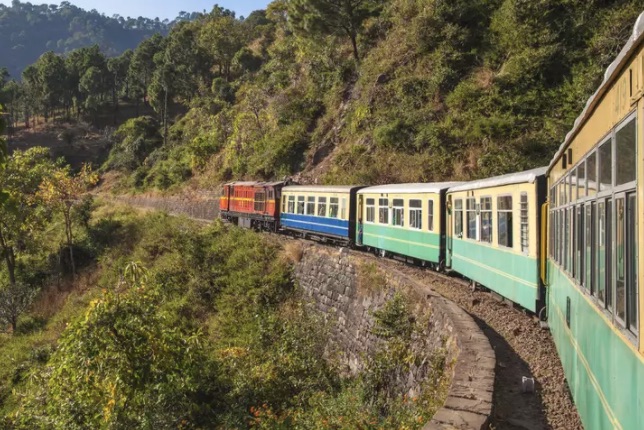
Running through 103 tunnels and 969 bridges, and 919 stunning curves, the Kalka Shimla train track is one of the world’s unique and most scenic railway tracks. Having a total distance of 96 Km from Kalka to Shimla, this track has 18 railway stations and 5 level crossings. The rail track rises from Kalka at 640 m to the cool climes of Shimla at 2.060 m. Compared with Australia’s oldest railway, Puffing Billy, I have named this article the Kalka-Shimla railway, the Indian Puffing Billy.

Both railway tracks were built almost simultaneously in the early twentieth century. Though the Kalka Shimla train route was completed on November 2, 1903, it was opened to the public only on January 1, 1906. It is said that this railway line was first drawn in November 1847, almost 50 years before it was actually constructed. Lord Curzon, the then British Viceroy to India, inaugurated this magnificent train in November 1903. The Kalka-Shimla Railway was built to connect Shimla, the summer capital of India during British rule, with the Indian rail system. The five-hour journey is one of the best train journeys for tourists operated by the Indian Railway.
Train track passes through scenic landscapes
Natural beauty and pleasant weather greet you the whole way. A cool breeze sweeps across faces as the train crosses one station after another, like Taksal, Gumman, Dharampur, before reaching Barog, which is almost the mid-point of the journey. This journey encompasses a vast display of awe-inspiring landscapes. Barog is a colonial showpiece with bougainvillaea clusters tumbling down the walls. This station is one of the most beautiful and well-maintained on this track. From here, you can see the towering mountains. At Barog, we pass through the biggest tunnel.

A tragic tale of Engineer Barog
A tragic story is associated with the construction of this railway track. The longest tunnel at Barog is named after engineer Barog, who sacrificed his life while attempting to construct it, but failed, resulting in the waste of government funds. Barog committed the mistake of digging the tunnel from both ends of the hill. The ends of the tunnels could not meet due to a misalignment.
It is said that the British authorities imposed a fine of Rs 1 on him for wasting government money in the tunnel. The British engineer could not digest this humiliation and shot himself in sheer desperation while walking with his pet dog. He killed himself near what is now the state government-run Barog Pine Wood Hotel. After his death, the tunnel work done by Barog was left aside, and a new tunnel was constructed a little farther from the old one. After Barog come other beautiful destinations like Solan, Shogai, and Koti, all of which have wonderful scenery with towering mountains and deep, lush forests. You feel like being amid nature throughout the entire journey.
UNESCO listed it as a World Heritage in 2008
It is a heritage train, offering breathtaking views and stunning scenery throughout. Tracking through beautiful surroundings brings you closer to nature and is a wonderful experience. Its speed slows down as the train ascends through steep mountains and curves. This journey runs on a narrow gauge, taking passengers with breathtaking views of rugged mountains. On the way, there are lush pine forests and waterfalls. And picture-perfect hill stations along the way that will definitely tempt you to disembark and bask in their beauty. The entire journey takes about five and a half hours.
Earlier, the train was powered by a steam engine, but now it is powered by a diesel engine. It runs at 40 to 45 km per hour, up from 22 km per hour. To preserve the railway’s heritage, it is suggested that steam engines be preferred, as with the Puffing Billy train in Australia.
In July 2008, UNESCO’s World Heritage Committee added the Kalka Shimla train track to the World Heritage List. On 9th Nov 2008, UNESCO officially declared this railway line a World Heritage Site. Also, the Guinness Book of Rail Facts listed this track as the greatest narrow-gauge engineering achievement in India.
Special Trains on specific days
They equipped this train service with standard car seats and have nine halts. Passengers can get off at the stations along the way and nourish their eyes and souls with beautiful scenery. There are also two heritage carriages operating on this route: Shivalik Queen and Shivalik Palace Tourist Coach. Both are luxury services with ultra-modern facilities, including an onboard kitchen, refrigerator, dining table, and folding-cushion beds. These trains usually operate once a week, from March until September. During the high season (May-July, September-October, and December-January), several special holiday trains also run on this route due to heavy tourist traffic.
Another such heritage train in Melbourne is the Puffing Billy train, a blend of history, heritage, and a winery lunch
Chasing Clouds: A Beautiful Journey from Sacred Ganga to Mountains

Chasing Clouds: A beautiful journey from Haridwar to Mussoorie and Landour, exploring monsoon mountains, misty roads, nature, love and unforgettable moments.


No Comment